Nara in 1 Day
Is 1 day enough for Nara?
One day is perfect for Nara. The main sights — Nara Park with the deer, Todai-ji Great Buddha, Kasuga Taisha shrine, and Naramachi — form a natural walking loop that takes 4–5 hours at a relaxed pace. Nara is better as a day trip than an overnight: once you have done the temple circuit, the evenings are quiet.
Nara is the day trip that exceeds expectations every time. Free-roaming sacred deer, the largest wooden building in the world, and a bronze Buddha 15 meters tall — all within walking distance of each other. One focused day is exactly the right amount.
At a Glance
| Where | Kansai region, easily reached from Kyoto or Osaka |
| Time needed | 4-5 hours for the core loop, a bit longer if you add Naramachi or the western temples |
| Cost | Roughly 2,500-3,500 yen per person for entry fees, deer crackers, and lunch, plus train fare |
| Getting there | Around 35-45 minutes from Kyoto or Osaka by Kintetsu or JR |
| Best time | Arrive by 9 am; spring and autumn are the most comfortable and most crowded seasons |
Getting to Nara
From Kyoto
Kintetsu Nara Line: Kintetsu Kyoto Station (adjacent to JR Kyoto Station) direct to Kintetsu Nara Station. 35 minutes by Tokkyu express, 760 yen. The most convenient option.
JR Nara Line: Kyoto Station to Nara Station. 45–50 minutes by Miyakoji Rapid, 720 yen. Covered by JR Pass — see the Japan passes and deals guide if you are still deciding whether a pass makes sense for your route, and how to use trains in Japan for ticket-machine basics.
Arrive at either Kintetsu Nara Station or JR Nara Station — both are within walking distance of Nara Park (15 minutes on foot from either, or a 5-minute taxi).
From Osaka
Kintetsu Nara Line: Osaka Kintetsu Namba Station direct to Kintetsu Nara. 40 minutes by Kyuko express, 680 yen.
From Osaka Station (JR): Osaka to Nara via Yamato-ji Line or Osaka Loop Line connection, about 55 minutes, 820 yen. Covered by JR Pass.
Morning: Nara Park and the Deer (9:00–10:30)
The Deer
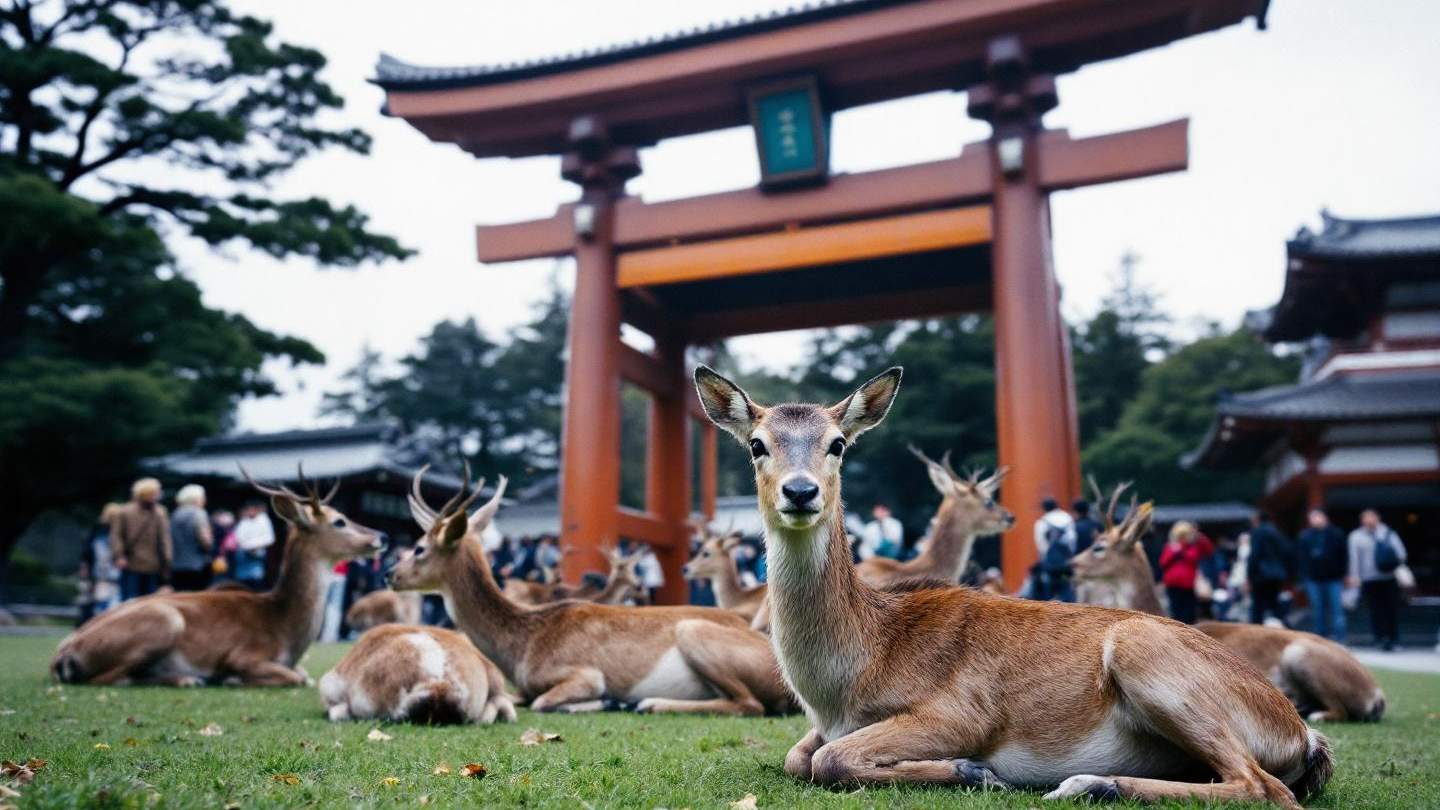
Nara Park is home to approximately 1,200 free-roaming sika deer, which Shinto tradition holds as sacred messengers of the gods. They wander freely through the park, up to temple steps, into cafes, along shopping streets — completely uncaged and entirely comfortable around people.
Buy shika senbei deer crackers from one of the park vendors (200 yen per bundle). Hold them visibly and the deer will approach. The bowing behavior — learned over generations of interaction with tourists trying to make them bow — is genuine and strange and wonderful. They bow, you hand over a cracker, both parties are satisfied.
Morning deer behavior is calmer than afternoon. By 2–3 pm, the deer that congregate near the main entrance can become aggressively food-focused and will nudge, butt, and occasionally gnaw on bags and clothing. Gentle but persistent.
Kofuku-ji (brief stop)
Kofuku-ji Temple sits between the stations and the main park area — a five-storied pagoda (one of Japan’s tallest at 50.1 meters) and a two-storied eastern golden hall. The pagoda is one of the most photographed buildings in Nara. Entry to the national treasure hall is 800 yen if you want to see the Buddhist sculpture collection (excellent). Otherwise, the exterior and courtyard are free.
Late Morning: Todai-ji Temple (10:30–12:30)
The Great Buddha Hall
Todai-ji’s Daibutsuden (Great Buddha Hall) is the largest wooden structure in the world. The current building, built in 1709, is a reconstruction — and is two-thirds the size of the original. It still houses the Daibutsu, a 15-meter bronze Buddha that has sat in this hall since 752 AD.
Entry is 600 yen. Allow 45–60 minutes.
Inside: the Buddha is extraordinary at scale — the lotus throne it sits on is 3 meters tall, the face alone is 5 meters wide. On either side stand guardian statues of similar enormous scale. Walk the full circuit around the base of the statue.
The wooden pillar with a hole near the base — said to be the same size as the Daibutsu’s nostril — attracts visitors who attempt to squeeze through it. Success is said to guarantee enlightenment. The hole is genuinely small (37 cm wide). Try if you are appropriately built.
Nara Great Buddha and Todai-ji 2-Hour Tour
Expert-guided 2-hour tour of Todai-ji and the Daibutsu — the history of Japan's largest bronze Buddha, the construction story of the Great Hall, and the significance of Nara in Japanese religious history.
Nigatsu-do
A 15-minute walk east from Todai-ji main hall brings you to Nigatsu-do — a subsidiary hall perched on the hillside above the park. The wooden deck extends out over the treetops with a panoramic view of Nara Park and the city beyond. Free to enter. In early March, the Omizutori fire ceremony here is one of Japan’s most dramatic festivals — monks run the blazing torches around the upper gallery after dark.
Midday: Kasuga Taisha Shrine (12:30–14:00)
Kasuga Taisha is a 15-minute walk east through the deer park from Todai-ji. This 8th-century Shinto shrine is famous for its hundreds of bronze and stone lanterns — donated by worshippers over centuries. The forest path leading to the shrine gates is one of Nara’s most atmospheric approaches.
Entry to the outer precincts is free. Entry to the inner treasure hall is 500 yen. The lanterns are spectacular during the twice-yearly Mantoro lantern festivals (February and August) when all 3,000 are lit simultaneously.
The forested hillside behind the shrine is part of the Kasugayama Primeval Forest — a UNESCO World Heritage natural site that has been protected from logging and development since the 8th century. Japan’s oldest protected forest. You can walk into it for free.
Nara Half-Day Tour — Deer Park, Todai-ji & Kasuga
Half-day guided tour covering Nara Park's deer, Todai-ji's Great Buddha, and Kasuga Taisha shrine — with a local English-speaking guide who provides context on Nara's role as Japan's first permanent capital.
Afternoon: Naramachi and Lunch (14:00–17:00)
Lunch
Naramachi begins at the south edge of Nara Park — the preserved merchant district of the Edo period, with machiya townhouses converted into cafes, craft workshops, and restaurants.
Kakinoha-zushi is Nara’s signature dish: mackerel or salmon sushi pressed in persimmon leaves, which impart a subtle flavor and help preserve the fish. Available at local specialty shops on the main Naramachi streets (1,000–1,500 yen for a set). Worth seeking out over generic tourist ramen.
Other options: matcha soft-serve ice cream (300–400 yen) from any of the shops near Kofuku-ji, or a full set lunch at one of the teahouse-style cafes in Naramachi for 1,200–2,000 yen.
Naramachi Walking (14:30–16:30)
Naramachi proper is a quiet 30–45 minute walk through preserved streetscapes. Many of the machiya townhouses are open to the public as small museums or craft galleries (usually free or 200 yen). The Naramachi Mechanical Toy Museum is slightly eccentric and charming.
The streets south of Sarusawa Pond are the most intact. The pond itself (free, 5-minute walk from Kofuku-ji) reflects the five-storied pagoda in the right light conditions and is one of Nara’s quieter pleasures.
If time remains after Naramachi: Toshodai-ji and Yakushi-ji temples are a 20-minute bus ride west of the main park area — UNESCO World Heritage sites from the Nara period with superb Buddhist sculpture and significantly fewer tourists than Todai-ji. Worth it if you arrive in Nara by 9 am and have covered the main circuit efficiently.
Getting Around Nara
The main sights are entirely walkable from both Kintetsu Nara and JR Nara stations. A comfortable pace covers: stations → Kofuku-ji → Todai-ji → Nigatsu-do → Kasuga Taisha → Naramachi in about 4–5 hours including temple entry time.
City buses cover the western temples (Toshodai-ji, Yakushi-ji) and Horyu-ji for visitors who want to go beyond the park circuit. IC card works on Nara buses.
Taxis are available near both stations and near the major temple entrances. For late afternoon return with tired legs: taxi from Naramachi to the station is 600–800 yen.
What to Skip in 1 Day
Horyu-ji Temple. The oldest wooden structure in the world (established 607 AD) and one of Japan’s most significant Buddhist sites — and a 20-minute bus ride from central Nara. On a 1-day visit, this competes directly with Kasuga Taisha and the Naramachi loop. Save it for a longer Nara visit.
Isuien and Yoshiki-en gardens. Two classical Japanese gardens near Todai-ji that are excellent for slow travel but not essential on a 1-day circuit focused on scale and historical weight.
Evening in Nara. Nara closes early. Restaurants mostly shut by 8 pm, the temple district is dark and quiet by 6 pm. Return to Kyoto or Osaka for dinner unless you are genuinely interested in a Nara overnight.
Tips for a 1-Day Nara Trip
- Arrive by 9 am. Morning light on Todai-ji’s hall is the best of the day, and the deer behave better before the afternoon rush.
- The deer bow on command — but only if they see you have senbei crackers. Hold the crackers visibly first, then bow. They will bow back.
- Do not feed the deer anything other than shika senbei. Human food and plastic bags cause digestive problems. The vendors sell the approved crackers for a reason.
- Nara is compact. Wear comfortable shoes — the main circuit is 5–7 kilometers of walking.
- Todai-ji’s Great Buddha is most impressive early in the morning when the hall is lit by shafts of light through the upper windows.
- The Kintetsu train from Kyoto to Nara is slightly faster and more direct than the JR. Use it if you do not have a JR Pass to optimize.
- Summer afternoons in Nara (July–August) are genuinely hot. Start early, finish by 2 pm, or stay in shaded Naramachi for the afternoon.
Nara as Part of a Longer Trip
If you have more than a single day to give Nara, the Nara things to do guide covers the sites this itinerary deliberately skips — Horyu-ji, the Isuien and Yoshiki-en gardens, and the Kasugayama primeval forest — in more depth. Most travelers still treat Nara as a day trip rather than an overnight, slotting it into a Kyoto or Osaka base, or as one stop within a broader route using the Japan itinerary planner.
More tours on Viator
Top-rated experiences with verified reviews, bookable on Viator (a Tripadvisor company).
 Viator
World Heritage Kyoto & Nara Uji Authentic Matcha Experience
FromUSD 124Check availability → Viator
Nara Half Day Trip Walking Tour (Private Option Available)
FromUSD 101Check availability → Viator
Nara Early Morning Tour (Kyoto or Osaka Departure Available)
FromUSD 72Check availability → Viator
Kyoto Private Tour – Full Day with Local Guide & Nara Option
FromUSD 179Check availability → Viator
Nara 6hr Private Tour with Government-Licensed Guide
FromUSD 140Check availability → Viator