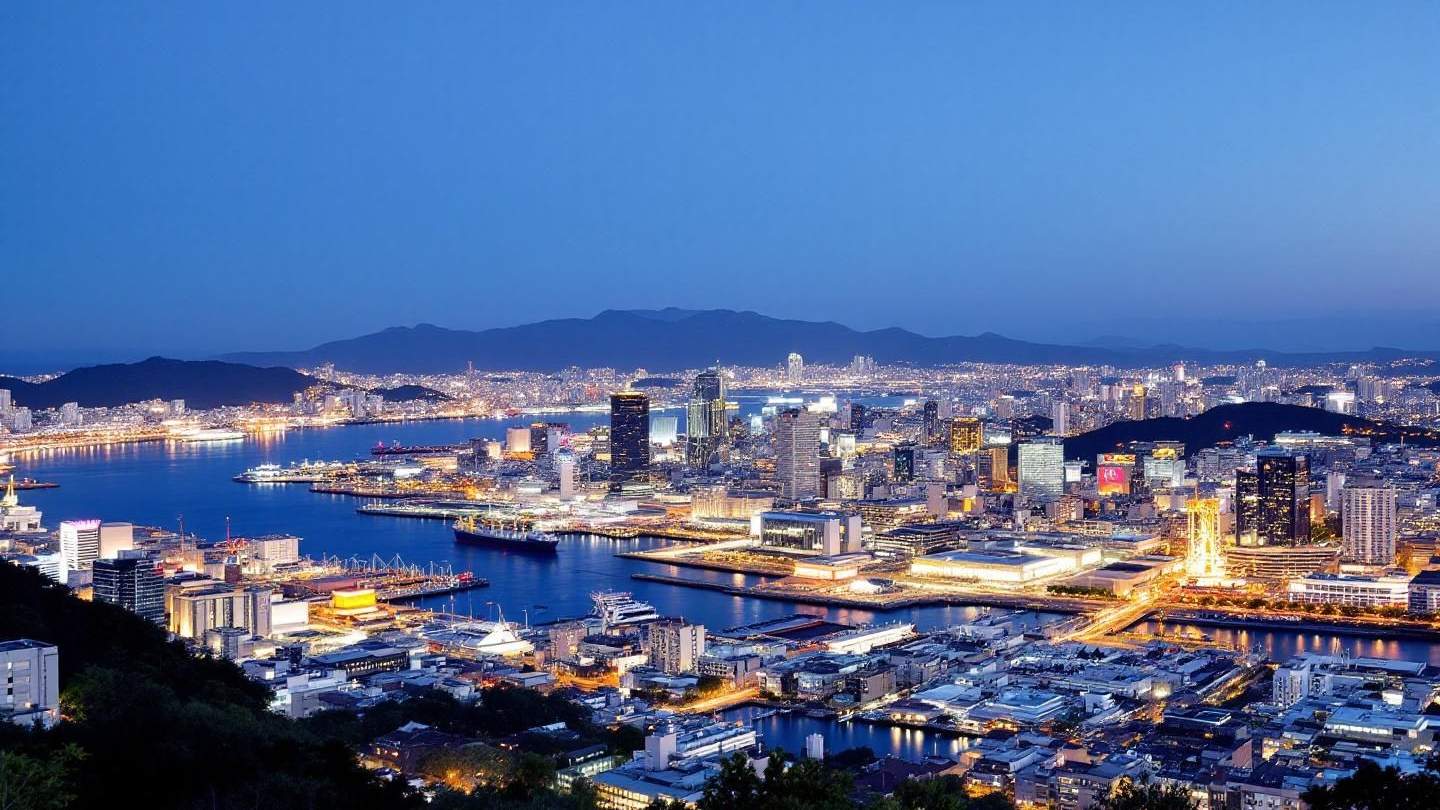
Kobe
Complete Kobe travel guide. World-famous beef, historic harbor, sake breweries in Nada, vibrant Chinatown, and stunning mountain-harbor scenery.
Quick Facts
- Best For
- Beef, Sake, Harbor Views
- Days Needed
- 1-2 days
- Best Season
- Spring and Autumn
- Getting There
- 30 min from Osaka
- Getting Around
- City loop bus + walking
- Budget (per day)
- 6,000-25,000 yen
Why Visit Kobe
Kobe is where Japan looks outward. It makes an easy day trip from Osaka — just 30 minutes by train — and pairs beautifully with a visit to Kyoto. Set between the steep slopes of the Rokko mountain range and the curve of Osaka Bay, it has been an international port city since 1868, when Japan opened its doors to foreign trade and Kobe became the entry point for much of the Western world. That history left a tangible mark: European-style mansions on the hillside, a Chinatown crammed with dim sum and steamed buns, a sake-brewing district that has been operating since the 17th century, and an effortlessly cosmopolitan atmosphere that distinguishes Kobe from virtually every other Japanese city.
The headline attraction is obvious: Kobe beef. The cattle reared in the Tajima region of Hyogo Prefecture, and specifically the A5-grade wagyu sold and served in Kobe’s restaurants, is among the most expensive and intensely marbled beef in the world. Eating it here, at the source, is one of Japan’s great food experiences — and understanding what makes it genuinely special is part of the visit.
But Kobe rewards even visitors who do not eat beef. The harbor is beautiful in a way that feels authentically working rather than manufactured. Kitano-cho, the old foreign residential district, is fascinating architectural evidence of 19th-century globalization. The Nada sake district produces roughly 30% of Japan’s national sake output. And the views from the Rokko mountains or from the Nunobiki Herb Garden gondola — the city, the bay, and beyond it Osaka in the haze — are among the best urban panoramas in western Japan.
It is an excellent day trip from Osaka, but it deserves overnight time.
Kobe Beef — The Complete Guide
What Kobe Beef Actually Is
“Kobe beef” is one of the most abused terms in global food marketing. In Japan, it has a strict legal definition that very few animals meet. True Kobe beef (神戸ビーフ) must come from Tajima-gyu cattle — a specific bloodline of Japanese Black cattle raised in Hyogo Prefecture. The animal must be born, raised, and slaughtered within Hyogo Prefecture. It must achieve a Beef Marbling Standard (BMS) score of 6 or above on a scale of 1-12, a Meat Quality Grade of 4 or 5, and a Yield Grade of A or B. The animal is certified by the Kobe Beef Marketing and Distribution Promotion Association, and each certified piece of meat comes with a certificate of authenticity bearing a 10-digit ID number you can verify online.
What you actually receive when you eat certified Kobe beef: extraordinary fat marbling distributed evenly through the muscle like fine lace. When cooked, this fat melts at near-body temperature, producing a buttery richness and depth of flavor that is unlike any other beef in the world. The texture is genuinely different — almost yielding, tender to a degree that seems implausible for meat. A good A5 Kobe sirloin steak will have a BMS of 10 or above; the difference between BMS 6 and BMS 12 is significant and worth paying for if budget allows.
What to Order and How to Eat It
The most common way to eat Kobe beef in Kobe’s restaurants is as a teppanyaki course, where a chef cooks the meat on a hot iron plate in front of you, serving it in sequence with vegetables, rice, miso soup, and dessert. Courses typically run 12,000-30,000 yen per person depending on the grade and weight of beef included. A 100g serving of certified Kobe sirloin is the usual minimum; 150g is recommended for a satisfying meal.
Alternatively, shabu-shabu and sukiyaki restaurants serve Kobe beef as paper-thin slices cooked at the table in hot broth or sweet soy-egg dipping sauce. This approach highlights the marbling differently and costs slightly less — courses from 10,000 yen per person.
For a more affordable introduction, some restaurants serve Kobe beef as a hamburger steak (hanbaagu) for 2,500-5,000 yen, or as a small steak lunch set for around 4,000-8,000 yen. These use certified beef but typically from lower grades within the qualifying range.
Where to Eat Kobe Beef
Mouriya (モーリヤ) has been serving Kobe beef teppanyaki since 1915 and is the most respected name in the city. The Kitanozaka main restaurant has four floors and a long track record. Courses from around 15,000 yen per person. Reserve at least a week ahead for dinner.
Steak Land Kobe near Sannomiya Station offers a more accessible entry point — a Kobe beef set lunch can be had here for around 5,000 yen, making it popular with first-time visitors who want the experience without the full-course commitment. Less formal, no reservation needed for lunch.
Tor Road Steakhouse on the old foreign residents’ street has a convivial atmosphere and good mid-range Kobe beef courses from around 10,000-18,000 yen.
Spotting Fake Kobe Beef
Outside Japan, “Kobe beef” is essentially meaningless as a term — no certified Kobe beef was legally exported until 2012, and exports remain tiny. In Japan, any restaurant serving authentic Kobe beef will have the Kobe Beef Association certification plaque visible. Ask to see the certificate for your specific cut — the 10-digit traceability number should be provided on request. If a restaurant cannot produce it, the beef is likely Tajima-gyu or other wagyu of lesser grade, which may still be excellent but is not technically Kobe beef.
Kitano-cho — The Foreign Houses District
Kitano-cho (北野町) sits on the lower slopes of the Rokko mountains, a 20-minute walk north from Sannomiya Station or 10 minutes on the City Loop Bus. In the late 19th century, foreign merchants and diplomats required to live in the international settlement built Western-style residences on this hillside — brick, timber-frame, and stone mansions with gardens, bay windows, and ornate ironwork.
Around 20 of these buildings (ijinkan, or “foreign houses”) survive and can be visited. Some are free to enter as they now house cafes or shops; others charge admission of 500-1,000 yen. The most rewarding is Weathercock House (風見鶏の館), a red-brick German villa built in 1909 with period furnishings intact and a distinctive iron weathervane cock on the turret. Admission is 500 yen. Beside it, the Moegi House is a mint-green American-style wooden structure, also 500 yen. A combination ticket for multiple houses costs around 1,500-2,000 yen and covers the most significant ones.
The neighborhood itself is worth exploring even without entering the houses. The sloped cobblestone streets, the vine-covered walls, the coffee shops and boutiques occupying 19th-century buildings — it is a corner of Kobe that feels genuinely European rather than performatively so. On clear days the views down across the city to the bay are exceptional.
Meriken Park and the Harbor
Meriken Park (メリケンパーク) is Kobe’s harborfront public space, centered on the Port of Kobe monument — a preserved section of harbor pier damaged in the 1995 Great Hanshin Earthquake, left deliberately intact as a memorial. The earthquake killed over 6,400 people and essentially flattened large sections of Kobe; visiting the earthquake memorial here is a sobering reminder of the city’s resilience.
The park contains the Kobe Maritime Museum (入場料 900 yen, open Tuesday-Sunday 10am-5pm), which traces the history of the port with ship models, navigation instruments, and a thorough account of the city’s international trading history.
The harborfront walking area extends east to the Meriken Wharf complex and the distinctive Kobe Port Tower — a 108-meter red lattice observation tower (admission 700 yen) that has become the symbol of the city. The views from the top across the harbor and bay are best at dusk when the light is warm and Awaji Island is visible in the distance.
The Harborland (ハーバーランド) area slightly west of Meriken Park has shopping centers, restaurants, and a scenic boardwalk that is very pleasant in the evening. The umie mall and brick warehouse buildings along the waterfront have good food options at all price ranges.
Nunobiki Herb Garden and Ropeway
The Nunobiki Herb Garden (布引ハーブ園) sits on the mountainside above central Kobe, reached by a gondola ropeway that departs from the top of the Shin-Kobe Station building (a 5-minute walk from Shin-Kobe Shinkansen station). The ropeway ascends 400 meters in 10 minutes, and the views over the city and harbor visible from the gondola and the garden terraces are among the best accessible in Kobe without serious hiking.
The garden itself — Japan’s largest herb garden — covers 20 hectares across multiple terraced levels with lavender, roses, mint, chamomile, and hundreds of other herbs in seasonal display. The best season is late spring (May-June) when the roses peak; the garden is also pleasant in autumn. A small cafe at the upper station serves herb-infused soft cream and tea using plants grown on-site.
Round-trip ropeway ticket with garden admission: 1,800 yen for adults. The ropeway operates daily except Thursdays (and Wednesdays in winter), 9:30am-5pm (extended hours in summer evenings). The midway station allows pedestrians to walk down through the Nunobiki Falls trail, a pleasant 40-minute descent through forest to central Kobe — highly recommended if the weather is clear.
Nada Sake Breweries
The Nada district (灘) east of central Kobe along the railway line produces around 30% of Japan’s total sake output. For the broader picture of Japanese food and drink, see the Japanese food guide, making it the most significant sake-producing region in the country. The combination of excellent water drawn from the Rokko mountains (known as miyamizu, famous for its mineral composition), locally grown Yamada Nishiki rice, and sea breezes from Osaka Bay created conditions for sake brewing that have been exploited since the 17th century.
A cluster of major breweries line the area around Uozaki and Sumiyoshi stations on the Hanshin Railway. Most offer free entry to their museum or brewery floor and free or low-cost tasting:
Hakutsuru Sake Brewery Museum (白鶴酒造資料館) is the largest and most organized, with a full walk-through of traditional brewing techniques on recreated equipment from the Meiji era. Free entry. Open 9:30am-4:30pm (closed Monday). Located a 10-minute walk from Sumiyoshi Station.
Kiku-Masamune Sake Brewery Museum offers a similar experience with excellent bilingual panels explaining the kimoto and yamahai brewing methods. Free entry, small tasting included.
Sawanotsuru Museum (沢の鶴資料館) is smaller and quieter, with atmospheric original Meiji-era timber brewery buildings. Free entry.
Budget half a day for the Nada district if you are interested in sake seriously — visit two or three breweries, taste the differences between junmai, ginjo, and daiginjo styles, and pick up bottles (typically 1,200-3,500 yen) to take home. The breweries welcome questions and are used to international visitors.
Nankinmachi Chinatown
Nankinmachi (南京町) is one of Japan’s three major Chinatowns — alongside Yokohama and Nagasaki — occupying a compact grid of streets near the harbor, a 10-minute walk south of Sannomiya Station. The area developed in the 1860s when Chinese merchants came to trade through Kobe’s new international port.
Today the main East-West street (about 200 meters long) and its crossing north-south street are lined with Chinese restaurants, roast meat stalls, dim sum vendors, and shops selling imported Chinese ingredients and products. The food is primarily Cantonese and Shanghainese in style. The roasted pork bun (cha siu bao) stalls operate from late morning and are excellent — 200-350 yen for a large bun.
Nankinmachi is dense and cheerful rather than profound, best visited for lunch (most restaurants open for both lunch and dinner, with lunch sets 800-1,500 yen) or for a wander while en route between the harbor and Sannomiya. The central plaza has a small bandstand and is the site of Chinese New Year celebrations in January or February.
Kobe Luminarie
Kobe Luminarie (神戸ルミナリエ) is an annual light installation held in December, established in 1995 as a memorial to victims of the Great Hanshin Earthquake. The installation runs for about two weeks in December, typically from a date in early December until just before Christmas. It consists of thousands of LED lights arranged into elaborate cathedral-like arched structures along the streets between Motomachi and the Higashi Yuenchi park.
The Luminarie attracts over three million visitors and the area around Higashi Yuenchi becomes extremely crowded on weekends and evenings. Visiting on a weekday evening after 8pm reduces the crowds. Entry to the Luminarie is free; a donation box is positioned at the exit and contributions of 500 yen or more are encouraged in recognition of its memorial purpose. The light installation is genuinely beautiful and carries genuine emotional weight for Kobe residents.
Mount Rokko Night Views
The Rokko mountains immediately north of Kobe offer what is frequently listed among Japan’s three greatest night views, alongside Hakodate and Nagasaki. From the Rokko Shidare observatory and the Rokko Garden Terrace complex at the top of the mountain (931 meters), the entire spread of Kobe, Osaka Bay, and the Kinki region is visible on clear nights — a carpet of lights from the sea to the mountains, with the dark harbor dividing land from water.
Access: take the Hankyu line to Rokko Station, then a bus to Rokko Cable-Shita, then the Rokko Cable ropeway up the mountain (around 600 yen one way), then a further connecting bus to Rokko Garden Terrace. Total travel time from Sannomiya: approximately 50-60 minutes. A taxi from the cable car top station is around 2,000 yen. The viewing area is open in the evenings in summer until 9pm.
Arima Onsen Day Trip
Arima Onsen (有馬温泉) is one of Japan’s oldest hot spring resorts. If you have tattoos, check our onsen and tattoos guide before visiting, sitting in a mountain valley just 40 minutes from Sannomiya by the Kobe Electric Railway (via Tanigami, around 680 yen). The town produces two types of spring water: kin-no-yu (golden water), which is rich in iron and salt and turns an orange-brown color, and gin-no-yu (silver water), a clear carbonated spring. Both types have been drawing visitors for over 1,300 years.
The main public bath facility is Taiko-no-Yu near the town center — a large modern spa complex (2,700 yen entry) that uses both spring types in different pools. For a simpler experience, Kin-no-Yu public bath (650 yen) in the town center is a classic, no-frills sento with the characteristic golden water.
The town itself is pleasant to walk: ryokan inns with wooden facades, souvenir shops selling Arima’s famous fine bamboo crafts (take-zaikumi), and steeply narrow lanes that climb the hillside. A two-hour afternoon visit is sufficient; staying overnight at a ryokan (from around 15,000 yen per person including dinner and breakfast) is genuinely special.
Getting to Kobe
From Osaka: JR Kobe Line (Shin-Osaka to Sannomiya, about 25-30 minutes, 410 yen). Hankyu Kobe Line (Umeda to Sannomiya, 30 minutes, 330 yen) — slightly cheaper. Both are frequent and comfortable.
From Kyoto: Shinkansen to Shin-Kobe (about 30 minutes, 3,580 yen). Alternatively, Hankyu Railway via Osaka for around 640 yen total in around 70 minutes — much cheaper but slower.
From Tokyo: Shinkansen to Shin-Kobe Station (about 2 hours 40 minutes on the Nozomi, around 16,000 yen, JR Pass applicable).
By Air: Kobe Airport (UKB) on Port Island receives domestic flights. Itami Airport (Osaka) is closer for some western Japan routes; both are accessible from Sannomiya.
Getting Around Kobe
Kobe’s main tourist areas are all within walkable distance of each other, with the notable exception of Nada (east) and Arima (north). The City Loop Bus (シティループ) is an orange tourist bus that circuits the key sights including Kitano-cho, Meriken Park, Nankinmachi, and Harborland on a fixed route. A single ride is 260 yen; a day pass is 700 yen and good value if you plan to use it more than three times.
The Hankyu and JR rail lines both run east-west through the city and are useful for reaching Nada. The subway connects Shin-Kobe (Shinkansen terminal) to Sannomiya. Taxis are plentiful and metered, with the base fare around 680 yen.
Best Time to Visit
Spring (late March to early May) brings comfortable temperatures and cherry blossom along the harbor and at Kitano-cho. Golden Week at the end of April/early May is busy; plan accommodation in advance. Autumn (October to November) offers clear skies and comfortable temperatures, ideal for the Rokko night views and the Herb Garden. December has the Luminarie (early-mid December). Summer (July-August) is hot but the harbor breezes and evening coastal walks are pleasant.
Local Food Beyond Beef
Kobe has a rich food culture that extends well beyond wagyu. Kobe-style Chinese dim sum in Nankinmachi, particularly the roasted pork buns and pan-fried dumplings, is excellent. Sweets: Kobe has a long European confectionery tradition — there are more chocolatiers and cake shops per capita than almost any Japanese city. The Freundlieb bakery (established 1924 in a converted church) is a Kobe institution for German-style bread and pastries. Akashi-yaki: the city of Akashi, 20 minutes west of Kobe, produces a softer, egg-rich version of takoyaki (octopus balls) served in a dashi broth rather than with sauce. Akashi-yaki (明石焼き) is available throughout Kobe and is a must-try snack at around 600-800 yen per serving.
Practical Tips
Kobe is extremely easy to navigate. The city is oriented simply: mountains behind, harbor in front, Sannomiya Station in the middle. Most tourists can orient themselves within 30 minutes of arrival.
The City Loop Bus day pass is worth buying on the morning of your visit if you plan to see Kitano-cho, Meriken Park, and Nankinmachi — it handles all three and saves the walk.
For Kobe beef, book teppanyaki dinner reservations at least a week ahead (Mouriya requires this minimum). If walking in without a reservation, Steak Land and several smaller Kitano-zaka area restaurants accommodate walk-ins for lunch.
Shoe comfort matters: Kitano-cho involves uphill cobblestone walking and the Nunobiki descent trail is uneven. Wear shoes you can walk in for three or four hours without complaint.
Kobe combines naturally with Osaka (30 minutes away) and Himeji (30 minutes in the other direction, for the finest castle in Japan). A two-day Osaka-Kobe-Himeji circuit is one of the most efficient and rewarding itineraries in western Japan.