Best Food Tours in Japan
Japan is one of the world’s great food nations — home to more Michelin-starred restaurants than any other country, a street food culture of extraordinary depth, and regional culinary traditions that vary as dramatically as the landscape. A guided food tour is one of the most effective ways to enter that world quickly. A knowledgeable local guide collapses the learning curve, turns language barriers into non-issues, and opens doors — literally and figuratively — to eating experiences that independent travelers rarely find on their first visit.
This guide covers the best food tours in Japan’s three major culinary cities: Tokyo, Osaka, and Kyoto. Each city has a distinct food identity, a different set of neighborhoods worth exploring on foot, and its own style of guided tour. Whether you want to eat sushi at Tsukiji at sunrise, work through kushikatsu skewers in a Shinsekai side street, or taste your way through Kyoto’s most atmospheric dining alley, this guide will help you find the right tour.
| At a Glance | Details |
|---|---|
| Where | Tokyo, Osaka, and Kyoto — each with a distinct culinary identity |
| Cost | Around ¥7,000–¥12,000 per person, tastings included |
| Time needed | 3–4 hours for most walking tours; half-day for market plus cooking class formats |
| Getting there | Meet on foot at a station exit; no transport booking needed beyond getting to the meeting point |
| Best time | Morning for markets (Tsukiji, Kuromon), evening for Gion and Pontocho |
Why Take a Guided Food Tour in Japan
The case for a guided food tour in Japan is stronger than in most countries. The barriers to independent exploration are real: menus are often entirely in Japanese, the queuing culture is opaque to newcomers, and the best establishments — the ones with no signage, no English, and a forty-year-old family recipe — are genuinely invisible to visitors who don’t know where to look.
A good guide provides selection (filtering the extraordinary from the merely fine), access (walking you into establishments that have no tourist footprint), and context (explaining why Osaka takoyaki tastes different from Tokyo takoyaki, what the kushikatsu no-double-dipping rule means socially, and what the seasonal ingredient on today’s menu signifies in Japanese culinary terms).
Guided food tours in Japan typically cost 7,000–12,000 yen per person and include all tastings. That price is competitive with — often below — what you would spend independently attempting to cover the same ground and eating at the same quality level. The added value of understanding what you are eating and why makes the guided format worth the premium.
Tokyo Food Tours
Tokyo has more restaurants than any other city on earth — over 80,000 by most counts, with a concentration of culinary talent that makes even neighbourhood convenience stores an interesting food destination. The areas most rewarding for guided food tours are the old wholesale market district around Tsukiji, the dense backstreet networks of Shibuya and Shinjuku, and the izakaya alleys of Yurakucho and Ginza.
Tsukiji and Sushi
Tsukiji’s outer market remains one of the world’s great food destinations even after the inner tuna auction moved to Toyosu. The outer market’s 400-plus stalls selling tamagoyaki, fresh fish, pickles, dashi, and specialist kitchen equipment remain in the original location, and the fish quality served at the surrounding sushi counters is exceptional. A tour combining a Tsukiji market walk with a sushi-making class offers both the market immersion and a hands-on culinary skill.
What to expect at Tsukiji: thick-rolled tamagoyaki from cast-iron pans (300–500 yen per piece), fresh oysters and sea urchin from open counters (300–600 yen per piece), premium tuna sashimi from vendors who know the provenance of every fish. A sushi-making session that follows typically runs 90 minutes to two hours: a chef demonstrates nigiri technique, guests roll and press their own pieces, and the class ends with eating what you made alongside miso soup.
Shibuya and Shinjuku
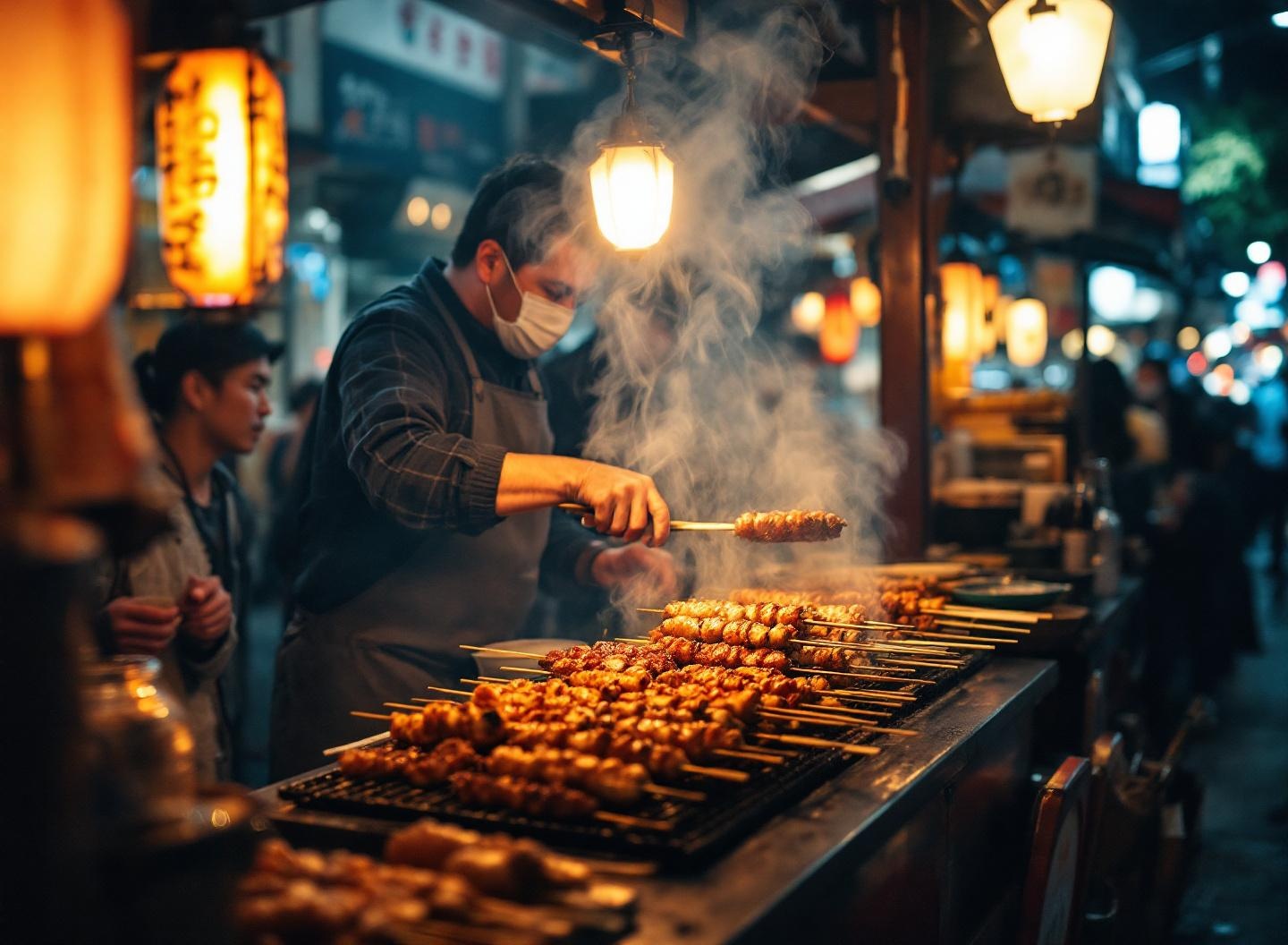
Shibuya’s food landscape divides between the high-visibility chains on the main streets and the genuinely excellent small operators tucked into the alleys behind Shibuya Station. A walking food tour through this area hits ramen stalls, kushiage counters, izakaya with standing-room-only sake service, and the market vendors who set up in the covered arcades of Togoshi Ginza or Nakameguro. Shinjuku’s Golden Gai and Memory Lane (Omoide Yokocho) are among the most atmospheric places to eat in Japan — narrow alley bars serving yakitori skewers over charcoal, barely wide enough for two people to pass each other.
Tsukiji Market Tour and Sushi Making
Explore Tsukiji Market then learn sushi at a top cooking school.
Tokyo Secret Food Walking Tour
3-hour culinary adventure through hidden backstreets with a local guide.
Shibuya Food Tour
Immersive food tour through Shibuya's best spots — ramen, gyoza, izakaya, and more.
What Makes Tokyo’s Food Scene Unique
Tokyo’s culinary identity rests on precision and tradition. The city has the highest concentration of specialized single-dish restaurants in the world: restaurants that serve only ramen, only soba, only tonkatsu, only tempura, only unagi — each one having refined a single preparation over decades. The commitment to craft over breadth means that even a modest neighbourhood ramen shop may have a more technically accomplished broth than a multi-dish restaurant anywhere else. Prices for quality are higher than Osaka (a premium ramen bowl runs 1,100–1,500 yen, versus 900–1,200 yen in Osaka), but the ceiling for excellence is correspondingly higher.
Osaka Food Tours
Osaka is Japan’s undisputed street food capital. The local concept of kuidaore — eating until you ruin yourself financially — is not a marketing phrase. It is a sincere cultural value, one that explains why Osaka households spend more on food per capita than any other Japanese city, and why the density of excellent eating options in Dotonbori and Shinsekai is genuinely staggering.
Dotonbori
The canal district of Dotonbori concentrates Osaka’s most famous street foods into a walkable strip: takoyaki, okonomiyaki, kushikatsu, fresh oysters, and grilled wagyu on skewers. A guided food tour here navigates the gap between the well-marketed chains and the establishments that have operated at the same standard since the 1940s.
Shinsekai
Shinsekai’s kushikatsu restaurants are older, less polished, and more authentic than any tourist-facing equivalent. Eating in a Shinsekai side-street counter — ten skewers, a beer, a handwritten menu in Japanese, no English signage — is one of the defining low-budget food experiences in the country.
Dotonbori Daytime Food Tour
Explore Dotonbori's street food — kushikatsu, takoyaki, and more with a local guide.
Dotonbori and Shinsekai Foodie Tour
Two iconic neighborhoods, kushikatsu, okonomiyaki, and local favorites in three hours.
What Makes Osaka’s Food Scene Unique
Osaka’s food culture is communal and competitive. Every vendor believes their version of a dish is the correct version, and the debate between rival takoyaki stalls two doors apart is conducted with the seriousness of a philosophical argument. The result for visitors is a city where even casual eating — street-corner takoyaki, a standing ramen counter, a basement izakaya — consistently exceeds expectations. Osaka food is also value-oriented: the assumption that good food should be accessible, not expensive, drives quality down to price points rarely seen in Tokyo.
Kyoto Food Tours
Kyoto approaches food differently from Tokyo and Osaka. Where Tokyo specializes and Osaka democratizes, Kyoto ritualizes. The city’s culinary tradition — kaiseki multi-course cuisine, kyo-ryori temple cooking, the careful preservation of seasonal ingredients — reflects its history as Japan’s imperial capital for over a millennium. Eating in Kyoto is inseparable from aesthetics, seasonality, and the particular atmosphere of the places where the food is served.
Gion and Pontocho
The Gion and Pontocho neighborhoods represent Kyoto’s most concentrated food experience for visitors. Pontocho is a single narrow alley running for 500 meters between the Kamo River and Gion, lined with some of the city’s finest small restaurants. In summer, the back terraces extend over the river for kawayu — open-air riverbank dining. Gion’s side streets contain machiya townhouse restaurants, sake bars serving Fushimi sake alongside small plates, and the kind of atmospheric setting that makes eating in Kyoto feel categorically different from eating anywhere else in Japan.
A guided food tour of Gion and Pontocho typically includes thirteen or more tastings across both neighborhoods: yudofu (tofu simmered in kombu dashi), seasonal yatsuhashi sweets, dashimaki tamago (Kyoto-style rolled omelette softer and less sweet than the Edo version), tofu-based appetizers, and sake from local Fushimi breweries. Evening tours add the atmospheric value of the alleys lit at dusk.
Nishiki Market
Nishiki Market — known as “Kyoto’s Kitchen” — is a 400-meter covered arcade with over 100 vendors selling fresh tofu, pickled vegetables (kyoto-zuke), fresh mochi, grilled skewers, and specialist foods unique to Kyoto’s culinary tradition. A market tour here provides direct access to ingredients and dishes that rarely appear on restaurant menus, sold by families who have operated the same stalls for multiple generations.
Gion and Pontocho Food Tour
Walk through Gion and Pontocho tasting 13 dishes with a local guide. Evening atmosphere, hidden alleys, and authentic Kyoto cuisine.
Comparing Food Tours by City
| City | Signature Dishes | Best Tour Type | Avg. Tour Cost |
|---|---|---|---|
| Tokyo | Sushi, ramen, tempura | Market + cooking class | 9,000–12,000 yen |
| Osaka | Takoyaki, kushikatsu, okonomiyaki | Street food walking tour | 7,000–9,000 yen |
| Kyoto | Kaiseki, yudofu, yatsuhashi | Evening neighborhood walk | 8,000–11,000 yen |
Practical Tips for Food Tours in Japan
Arrive hungry. Do not eat a substantial breakfast on tour day. The food included in a guided tour is generous — eight to thirteen individual tastings is standard — and arriving with appetite allows you to taste each dish properly rather than managing fullness from the second stop onward.
Dietary restrictions require advance notice. Japan’s food culture is deeply anchored in seafood, meat, and dashi stocks made from fish or shellfish. Vegetarian and vegan travelers need to inform tour operators at booking. Most experienced operators can modify routes, but they need preparation time. Allergies to shellfish or soy (which appears in almost all Japanese savory cooking) require explicit disclosure.
Group size matters significantly. Tours of six to ten people allow meaningful access to small counters and standing bars. Tours of twenty or more are logistically unwieldy in tight alley environments. Look for operators who specify maximum group sizes, and prioritize small-group formats.
Evening tours in Kyoto, morning tours in Osaka. Kyoto’s Gion and Pontocho are most atmospheric after dusk. Osaka’s Kuromon Market is best before 10am. Tokyo’s Tsukiji tours are worth starting at 7am. Matching timing to destination extracts the maximum from each experience.
Book well in advance. The best small-group tours fill one to three weeks ahead during peak seasons (cherry blossom in March–April, Golden Week in late April–early May, autumn foliage in November). Even outside peak windows, popular tours with strong reviews sell out several days ahead. Book as soon as your itinerary is confirmed.
Regional Food Tours Beyond the Big Three
Tokyo, Osaka, and Kyoto host the bulk of Japan’s guided food tours, but several other cities reward the same approach. Fukuoka is Kyushu’s food capital and the birthplace of tonkotsu ramen, with a yatai (open-air food stall) culture along the Naka River that is unlike anything on Honshu — see the Fukuoka food guide for specifics.
Hokkaido offers an entirely different culinary register built on fresh seafood, dairy, and corn, with its own food guide covering Sapporo’s ramen alley and Hakodate’s morning market. If your itinerary includes either city, a local food tour is worth the same premium it is in the big three — the language barrier and lack of signage are, if anything, more pronounced outside Tokyo, Osaka, and Kyoto.
Cooking Classes as an Alternative to a Food Tour
If you want to leave with a skill rather than just a full stomach, a cooking class is a strong complement to (or substitute for) a walking food tour. Tokyo, Osaka, and Kyoto all run dedicated sushi, ramen, and kaiseki-style classes — see the best cooking classes in Japan guide for a full comparison of formats and prices. Combining a market walk with a cooking class, as the Tsukiji tour above does, tends to be the most memorable single format because it pairs the sensory experience of the market with hands-on technique.
Frequently asked questions
Are food tours in Japan worth the cost? For most first-time visitors, yes — a 7,000–12,000 yen tour typically includes 8-13 individual tastings plus a knowledgeable guide who can access unmarked, no-English establishments that are effectively invisible to independent travelers. If you already read some Japanese and enjoy figuring out menus on your own, the value proposition is weaker.
Do I need to tip the tour guide? No. Tipping is not customary in Japan, including for tour guides, and attempting to tip can occasionally cause awkwardness. The tour price is the full price.
More tours on Viator
Top-rated experiences with verified reviews, bookable on Viator (a Tripadvisor company).
 Viator
Peaceful Hiroshima & Miyajima UNESCO 1 Day Bus Tour
FromUSD 124Check availability → Viator
World Heritage Shirakawa-go and Experience Tours from Kanazawa
FromUSD 118Check availability → Viator
World Heritage Kyoto & Nara Uji Authentic Matcha Experience
FromUSD 124Check availability → Viator
Nara Half Day Trip Walking Tour (Private Option Available)
FromUSD 101Check availability → Viator
Hiroshima Peace (Heiwa) Walking Tour at World Heritage Sites
FromUSD 91Check availability → Viator