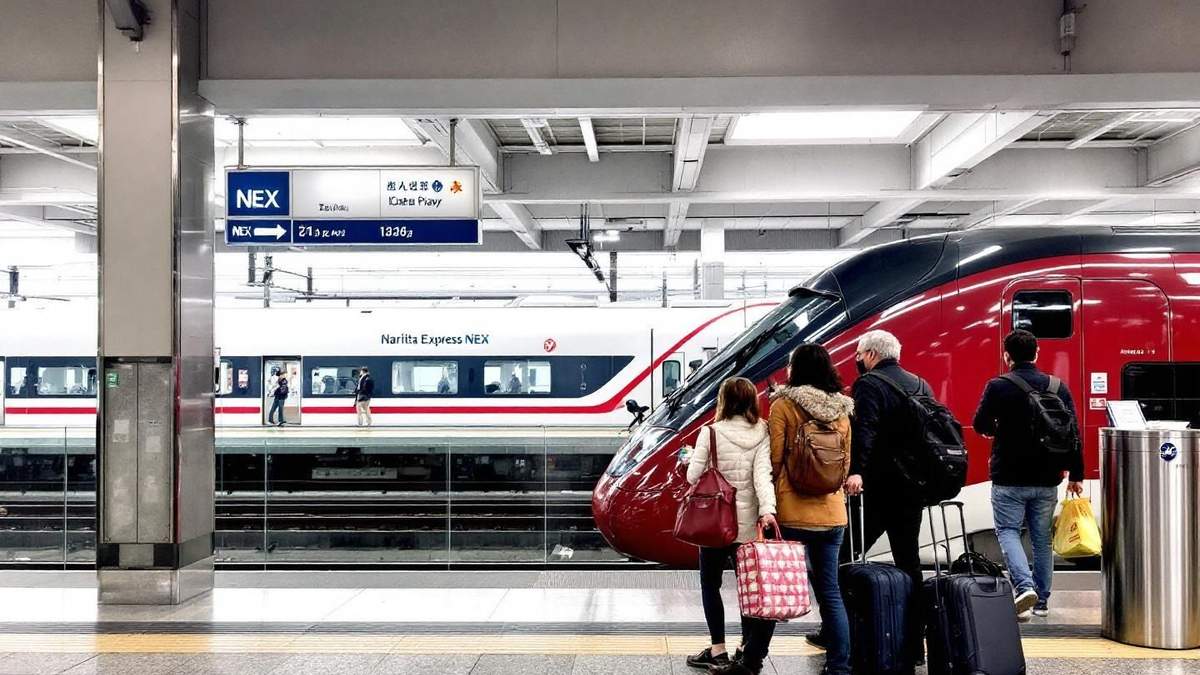
Narita Airport to Tokyo
Last updated: March 2026
What is the best way to get from Narita Airport to Tokyo?
The Narita Express (NEX) to Tokyo Station takes about 60 minutes and costs 3,250 yen. It is the most convenient option for most travelers. The Keisei Skyliner to Ueno is faster (41 min) but only goes to Ueno/Nippori. For budget travelers, the Access Express to Asakusa costs just 1,270 yen.
Before You Start: Know Your Destination in Tokyo
The best way to get from Narita Airport to Tokyo depends primarily on where in Tokyo you are staying. The journey takes between 40 minutes and 2 hours depending on the route, and your destination neighborhood determines which option saves you the most money, time, and effort. Choosing where to stay in Tokyo before reading this guide will make it much easier to pick the right transport option.
Before reading further, identify which area of Tokyo you are heading to:
- Central / Tokyo Station area: JR central hub, business district
- Shinjuku / Shibuya / Harajuku: Western Tokyo, most popular for tourists
- Asakusa / Ueno: Eastern Tokyo, traditional neighborhoods
- Akihabara / Ginza: Central-east Tokyo
- Roppongi / Azabu-Juban: South-central Tokyo
- Ikebukuro: Northwestern Tokyo
This guide will tell you the best option for each area under the recommendation section at the end.
Option 1: Narita Express (N’EX)
The Narita Express is a JR East dedicated airport express train running from Narita Airport Terminals 1 and 2/3 directly to the central Tokyo rail network. It is comfortable, reliable, air-conditioned, and requires no transfers for many Tokyo destinations.
Key Details
Operator: JR East Journey times (from Narita Terminal 1):
- Narita to Tokyo Station: approximately 60 minutes
- Narita to Shinagawa: approximately 71 minutes
- Narita to Shibuya: approximately 81 minutes
- Narita to Shinjuku: approximately 90 minutes
- Narita to Ikebukuro: approximately 96 minutes
- Narita to Yokohama: approximately 90 minutes
Fares (one way):
- To Tokyo Station: 3,250 yen
- To Shinjuku/Shibuya/Ikebukuro: 3,250 yen (same fare for all Tokyo metro stops)
- To Yokohama: 4,370 yen
Round-trip discount: The N’EX Tokyo Round Trip Ticket costs 4,070 yen (valid 14 days from purchase). This is always worth buying if you are returning to Narita from Tokyo — it saves 2,430 yen compared to buying two one-way tickets.
What to Expect
Trains run approximately every 30 minutes from about 7 am to 10 pm. Reserved seating is standard on all N’EX trains — you cannot sit in an unreserved car. Your seat assignment is printed on your ticket. Luggage racks are at the ends of each car, and overhead space is available for smaller bags. The train is double-decker on some formations; all seats are comfortable.
N’EX stops at Terminal 2/3 Station first, then Terminal 1 (adding about 10 minutes). If you arrive at Terminal 2 or 3, board here rather than waiting for the bus to Terminal 1.
Buying Tickets
Buy at the JR East Travel Service Center in the arrival hall of each terminal, or at any JR East green vending machine (touch-screen, available in English). You can also book in advance via the JR East website — advisable during peak travel periods (Golden Week, summer Obon, New Year) when trains fill up.
At the ticket counter, show your passport when purchasing the round-trip ticket (it is sold as a tourist discount product and requires identification).
Pros
- Direct service to multiple central Tokyo hubs without transferring
- Runs to Shinjuku, Shibuya, and Ikebukuro without the need to change trains
- Comfortable reserved seating, luggage space
- JR Pass-compatible (show your pass, pick up a seat reservation at the counter)
- No navigation complexity once you are on board
Cons
- More expensive than Keisei alternatives to eastern Tokyo
- Does not serve Asakusa, Ueno, or the eastern part of the city directly
- Runs only every 30 minutes; missing a train means a 30-minute wait
- Cannot use IC card (Suica/Pasmo) to pay the full fare (only for any supplemental local connection)
Option 2: Keisei Skyliner
The Keisei Skyliner is the fastest train from Narita to central Tokyo. It runs on the Keisei private railway network and terminates at Ueno and Nippori stations.
Key Details
Operator: Keisei Electric Railway Journey times:
- Narita Airport to Nippori: 36 minutes
- Narita Airport to Ueno (Keisei Ueno): 41 minutes
Fares (one way):
- Narita to Ueno/Nippori: 2,520 yen
Round-trip discount: Keisei Skyliner 2-way ticket costs 4,780 yen (compared to 5,040 yen for two one-way tickets — a modest saving).
Skyliner + Tokyo Subway 1-day/2-day/3-day ticket: A combined package sold to foreign visitors; the Skyliner fare plus unlimited Tokyo Subway rides for 3,400 yen (1 day), 3,600 yen (2 days), or 3,800 yen (3 days). If you plan to ride the subway heavily on your first and/or last day, this combination can save money. For a full overview of Tokyo’s things to do, plan your subway-heavy days in advance.
What to Expect
The Skyliner is fast. The 36-minute journey from Narita to Nippori is the quickest train option from the airport. Trains depart approximately every 20–40 minutes. Seating is reserved (assigned at time of purchase). The train is comfortable, modern, and has overhead luggage racks and end-of-car luggage space.
From Nippori, you can connect to the JR Yamanote Line (which circles central Tokyo) for 168 yen, reaching Shibuya in about 20 minutes, Shinjuku in 25 minutes, and Shinagawa in 15 minutes. From Ueno (Keisei), you connect to the Tokyo Metro or JR Ueno stations.
Buying Tickets
Available at the Keisei ticket counters and vending machines in each terminal’s arrival hall. Also available online in advance at the Keisei website. The Skyliner + Tokyo Subway combination ticket is only available in Japan (at Narita airport and a few central Tokyo locations).
Pros
- Fastest train from Narita to central Tokyo
- Cheaper than N’EX
- Good if you are staying in or near Ueno, Asakusa, or the eastern side of central Tokyo
- Skyliner + Tokyo Subway package is excellent value for the right traveler
Cons
- Terminates at Nippori and Ueno only — requires a transfer on the Yamanote Line to reach Shinjuku, Shibuya, or western Tokyo
- Not JR Pass-compatible
- Slightly fewer direct connections than N’EX for travelers heading to Shinjuku/Shibuya
Option 3: Keisei Access Express and Limited Express (Budget Rail)
The Keisei railway also operates slower services that are significantly cheaper than the Skyliner.
Keisei Access Express (via Aoto to Asakusa)
The Access Express runs from Narita Airport through Aoto to Oshiage (Skytree) and Asakusa via the Toei Asakusa Line. This is the cheapest rail option from Narita.
Journey time: Approximately 75–80 minutes to Asakusa Fare: 1,270 yen to Asakusa (no express surcharge)
The Access Express continues through the city, serving Shinbashi, Daimon, and Mita as well. If you are staying in Asakusa or Ueno, this is the best-value rail option by a considerable margin.
Keisei Limited Express
The Keisei Limited Express is a slower version of the Skyliner that does not require a seat reservation and costs less.
Journey time: Approximately 75–80 minutes to Keisei Ueno Fare: approximately 1,050 yen to Keisei Ueno
This is a cheap option for travelers who are not in a rush and are heading to the eastern side of Tokyo.
Pros of Budget Keisei Options
- Dramatically cheaper than N’EX or Skyliner
- Access Express serves Asakusa directly — perfect if that is your destination
- No reservation required; just tap your IC card or buy a simple ticket
Cons
- Significantly longer journey times (75–80 minutes vs. 36–60 for express options)
- More stops and therefore more crowded during peak hours
- Less comfortable seating on older rolling stock
Option 4: Limousine Bus (Airport Bus)
The Airport Limousine Bus (operated by Tokyo Airport Transport and other companies) provides coach service from Narita Airport directly to major hotels and transit hubs throughout Tokyo.
Key Details
Journey times: 90–150 minutes depending on destination and traffic. Tokyo’s highways can be significantly congested, particularly in evenings and on weekdays.
Common routes and fares:
- Narita to Tokyo Station: 1,000 yen (if booked in advance online), 1,300 yen at the counter
- Narita to Shinjuku: 1,300 yen (advance), 1,500 yen counter
- Narita to Shibuya: 1,500 yen (advance), 1,800 yen counter
- Narita to various hotels in the Odaiba, Roppongi, and Shinbashi areas: 1,300–2,000 yen
Many routes serve specific hotel stops, not just transit hubs. If your hotel is on the bus route, you can take the bus directly to the hotel door — a significant advantage with heavy luggage.
What to Expect
Buses are comfortable coaches with good luggage compartments underneath. They depart from designated bus bays in the arrival hall of each terminal (well-signposted). Frequency varies by route: Tokyo Station and Shinjuku routes run every 20–30 minutes; other routes may run every 60–90 minutes.
Seats can be reserved at the counter or online. During non-peak hours, you can usually board without advance booking.
Pros
- Cheapest option for some destinations (Tokyo Station for 1,000 yen beats N’EX)
- Direct to hotel door on many routes
- More luggage space than trains
- Comfortable for long journeys
- Good for travelers who are not confident navigating trains on first arrival
Cons
- Highly traffic-dependent — the 90-minute estimate can become 150 minutes during congestion
- Cannot guarantee arrival time, which creates stress if you have connecting plans
- Less reliable in the evenings and during peak hours
- No JR Pass compatibility
Option 5: Shared Shuttle Transfer
Several companies operate shared door-to-door shuttle services from Narita to Tokyo hotels. These are mini-vans or small buses that collect multiple passengers heading to the same area of Tokyo.
Providers: Friendly Airport Limousine, Narita Shuttle, JP Taxi (shared) Cost: approximately 3,500–5,500 yen per person Journey time: 90–180 minutes (door-to-door, including other passenger drop-offs)
Shared shuttles make sense if you have very heavy luggage and are unsure about train navigation, or if you have a late-night arrival when public transport is less frequent. They are slower and more expensive than most train options for individuals but can be convenient for families with young children.
Book in advance online. The driver or service representative meets you in the arrival hall with a sign.
Option 6: Taxi and Private Transfer
Standard Taxi
Taxis from Narita to central Tokyo are expensive.
Approximate cost:
- Narita to Shinjuku: 25,000–35,000 yen
- Narita to Shibuya: 25,000–35,000 yen
- Narita to Asakusa: 23,000–30,000 yen
Highway tolls are charged on top of the metered fare (typically 3,000–4,000 yen additional). Traffic can add substantial time to these estimates.
Standard taxis are not recommended from Narita for budget or moderate travelers. The N’EX costs 3,250 yen; a taxi can cost ten times as much.
Private Transfer (Pre-Booked)
Pre-booked private transfers (not metered taxis) are available from 12,000–20,000 yen for a private car to central Tokyo. These are worth considering for groups of three or four people splitting the cost, for families with young children and substantial luggage, or for late-night arrivals when other options are impractical.
Reputable providers: Japan Rail Taxi, S-Taxi Japan, various hotel concierge-arranged services.
Note: Uber does not operate at Narita Airport in the same way it does in most cities. Ride-hailing from the airport requires a pre-booked service.
Where to Find Platforms at Narita
Terminal 1
Train access: Take the B1 escalators down to the Narita Airport Station on the JR and Keisei lines (they share the station building but have separate platforms). Follow signs for “Trains to Tokyo” from the arrivals hall.
Bus access: Exit through the arrival lobby to the ground-level bus terminal, accessed through automatic doors on the first floor. Bus stops are numbered and well-signed in English; look for the route board to find your destination bus.
Terminal 2 and Terminal 3
Train access: Terminal 2 has an underground station (Narita Airport Terminal 2/3 Station) serving both JR and Keisei lines. The station is directly accessible from the arrival hall via escalators. Terminal 3 is a short walk from Terminal 2 and shares the same train station.
Bus access: Ground floor bus terminal, directly outside arrival exits.
Moving between terminals: A free shuttle bus connects all three terminals and runs every 10–15 minutes. The journey between Terminal 1 and Terminal 2/3 takes about 10–15 minutes.
JR Pass Holders
If you have a Japan Rail Pass:
- The N’EX is covered by the JR Pass. You do not pay the base fare. You do need to reserve a seat (free of charge), which you can do at the JR East Travel Service Center in the arrival hall or at any JR East ticket office.
- The Keisei Skyliner, Access Express, and limousine bus are NOT covered by the JR Pass.
- The JR Pass can be activated at the JR East Travel Service Center in the arrival hall if you have a pass exchange voucher.
If your JR Pass is active, taking the N’EX is the obvious choice — it is fast, comfortable, reserved-seat, and fully covered by the pass.
Late Night Arrivals
If your flight lands after 10 pm:
The last N’EX from Narita departs approximately 10:00 pm from Terminal 1 and arrives in Shinjuku around 11:30 pm. After this, N’EX service ends.
The last Skyliner departs around 10:00–10:30 pm.
Late night options:
- Keisei Limited Express: Slower trains continue past midnight (check the Keisei timetable for the latest departure from your terminal). Fare to Ueno is approximately 1,050 yen.
- Limousine Bus: Services continue to approximately midnight on major routes (Tokyo Station, Shinjuku). Check current timetables on the Tokyo Airport Transport website.
- Taxi: Available 24 hours. The cost (25,000–35,000 yen) may be acceptable if you are arriving after all trains have stopped, especially split between multiple travelers.
- Airport hotel: If your arrival is very late and your flight the next day requires an early return, staying at one of the airport-adjacent hotels (Narita Airport Rest House, Mercure, APA) eliminates the journey entirely. Rates run 8,000–15,000 yen per night. Having an eSIM already activated means you can navigate and book backup options from the moment you land, even late at night.
Tips for Families With Luggage
Traveling with children and multiple large suitcases complicates the airport-to-city journey. Practical advice:
Luggage forwarding (takuhaibin): Yamato Transport has a counter in both terminals at Narita. For 1,500–2,000 yen per bag, your suitcases are collected at the airport and delivered to your hotel the next morning. This is transformative. You walk through Tokyo carrying only a daypack while your luggage travels independently. Set this up on arrival before boarding any train.
Stroller navigation: Most Tokyo trains have elevators (marked on station maps with a wheelchair symbol), but stations vary in elevator coverage. The N’EX is a good choice with a stroller — you board from the platform without stairs, there are spaces for luggage/strollers at the car ends, and you emerge directly at large, accessible central stations.
Limousine bus with children: The coach seating format is often easier with children than a train if you have a lot of luggage. The luggage goes into the undercarriage compartment; you board without lifting suitcases up stairs. The downside is the longer and less predictable journey time.
Seat reservations with children: On the N’EX, reserving adjacent seats for a family is straightforward at the counter. On the Skyliner, do the same. Adjacent seating is not guaranteed if you board without a reservation.
Recommendation by Tokyo Destination
If you are staying near Tokyo Station, Ginza, or Marunouchi:
Take the N’EX to Tokyo Station. Direct, 60 minutes, no transfers. 3,250 yen one way or 4,070 yen round trip.
If you are staying in Shinjuku or Shibuya:
Take the N’EX to Shinjuku. Direct service, 90 minutes, 3,250 yen. Alternatively, take the Skyliner to Nippori (36 minutes) and transfer to the JR Yamanote Line to Shinjuku (25 minutes more) — total about 70 minutes, approximately 2,700 yen. The Skyliner route is faster and cheaper if you are comfortable making the transfer.
If you are staying in Ueno or Asakusa:
Take the Keisei Skyliner to Ueno (41 minutes, 2,520 yen) for Ueno, or the Keisei Access Express to Asakusa (75 minutes, 1,270 yen) for a cheap and direct connection to Asakusa.
If you are staying in Akihabara:
Take the N’EX to Tokyo Station, then the Yamanote or Keihin-Tohoku Line one stop north to Akihabara (3–5 minutes, 170 yen). Total: about 65 minutes, 3,420 yen. Or take the Skyliner to Nippori and the Yamanote Line south to Akihabara (15 minutes, 168 yen). Total: about 55 minutes, 2,700 yen.
If you are staying in Roppongi or Azabu:
The N’EX to Shibuya, then the Tokyo Metro Hibiya Line to Roppongi (7 minutes, 180 yen). Or the limousine bus directly to Roppongi, if your hotel is on a limousine bus route — check the Tokyo Airport Transport route map.
If you are staying in Ikebukuro:
The N’EX to Ikebukuro is direct and takes about 96 minutes (3,250 yen). Alternatively, the Skyliner to Nippori (36 minutes) then JR Yamanote Line to Ikebukuro (20 minutes, 209 yen) — total about 60 minutes, approximately 2,730 yen. The Skyliner combination is faster and cheaper.
If you are a JR Pass holder:
Use the N’EX at no additional cost (seat reservation required and free). This is the clear choice regardless of your Tokyo destination. See the JR Pass guide for full activation instructions and tips on activating your pass at the airport counter.
If budget is your absolute priority:
Take the Keisei Access Express to Asakusa (1,270 yen). Or the Keisei Limited Express to Keisei Ueno (approximately 1,050 yen) and transfer from there. These routes take 75–80 minutes but are significantly cheaper than any other option.
If you arrive late at night (after last trains):
Take a limousine bus if one is still running (check the Tokyo Airport Transport site for last departure times). If all buses and trains have finished, take a metered taxi (25,000–35,000 yen). Share the taxi with other travelers heading to the same part of Tokyo if possible.
Summary Comparison Table
| Transport Option | Destination | Journey Time | Cost | JR Pass |
|---|---|---|---|---|
| N’EX (Narita Express) | Tokyo Station | 60 min | 3,250 yen | Yes (free) |
| N’EX (Narita Express) | Shinjuku | 90 min | 3,250 yen | Yes (free) |
| Keisei Skyliner | Ueno / Nippori | 41 min | 2,520 yen | No |
| Skyliner + Yamanote Line | Shinjuku | 65 min | ~2,700 yen | No |
| Keisei Access Express | Asakusa | 75 min | 1,270 yen | No |
| Keisei Limited Express | Keisei Ueno | 75 min | ~1,050 yen | No |
| Limousine Bus | Tokyo Station | 90–150 min | 1,000–1,300 yen | No |
| Limousine Bus | Shinjuku | 90–150 min | 1,300–1,500 yen | No |
| Shared Shuttle | Hotel door | 120–180 min | 3,500–5,500 yen | No |
| Standard Taxi | Central Tokyo | 90–120 min | 25,000–35,000 yen | No |
One Final Note on IC Cards
Pick up your Suica or Pasmo IC card at the airport before boarding any train. The card covers all local train and subway journeys in Tokyo (and across Japan), can be topped up at any station machine, and is accepted at convenience stores, vending machines, and many restaurants. It costs 500 yen (refundable deposit) plus your initial charge. Load 2,000–3,000 yen to start.
The IC card does not cover the N’EX fare or the Skyliner fare — these require separate tickets. But everything you do in Tokyo after you arrive at your first station runs on the IC card, and having it ready from arrival day one removes a lot of friction. Our how to use trains in Japan guide explains the full IC card setup, including how to add Suica to your iPhone or Android before you land.
Once you arrive, consult the Tokyo things to do guide to start planning your first days. If you have a JR Pass, activate it at the JR East Travel Service Center in the arrival hall before boarding the N’EX — the train is then fully covered at no extra cost.