Miyajima
Complete Miyajima (Itsukushima) travel guide. The iconic floating torii gate, sacred temples, wild deer, hiking Mount Misen, and local oysters.
Quick Facts
- Best For
- Iconic Torii, Temples, Nature
- Days Needed
- Half day to 1 full day
- Best Season
- All year (autumn best)
- Getting There
- Ferry from Miyajimaguchi (10 min)
- Getting Around
- Walking
- Budget (per day)
- 3,000-8,000 yen
Why Visit Miyajima
Miyajima is one of those rare places where the photograph you have seen hundreds of times fails to prepare you for reality. It is typically visited alongside Hiroshima and is a highlight of a 10-day Japan itinerary. The island of Itsukushima — commonly known as Miyajima (宮島), meaning “shrine island” — lies 20 minutes from Hiroshima city in the Seto Inland Sea, and its great orange torii gate standing in the shallows at high tide is one of the defining images of Japan. It has been considered one of Japan’s three finest views (nihon sankei) since the 17th century, and it earns the designation.
But Miyajima offers far more than the torii shot. Itsukushima Shrine, the vermilion buildings extending out over the water, is a UNESCO World Heritage Site with a thousand years of continuous ritual. The summit of Mount Misen, at 535 meters, rewards hikers with views across the Seto Inland Sea and dozens of islands. Daisho-in Temple has an extraordinary accumulation of Buddhist statuary, bells, and atmospheric halls. The island’s oysters — plump, briny, grown in the clean cold waters of the inland sea — are some of the best in Japan. And the problem of tourist density, which is real and significant, can be entirely solved by timing your visit with basic intelligence.
Most visitors arrive on the 10am ferry, walk to the torii, take photos, eat lunch on the shopping street, and catch the 2pm ferry home. If you do the opposite — or better yet, stay the night — you get the island to yourself.
The Floating Torii Gate
What Makes It Special
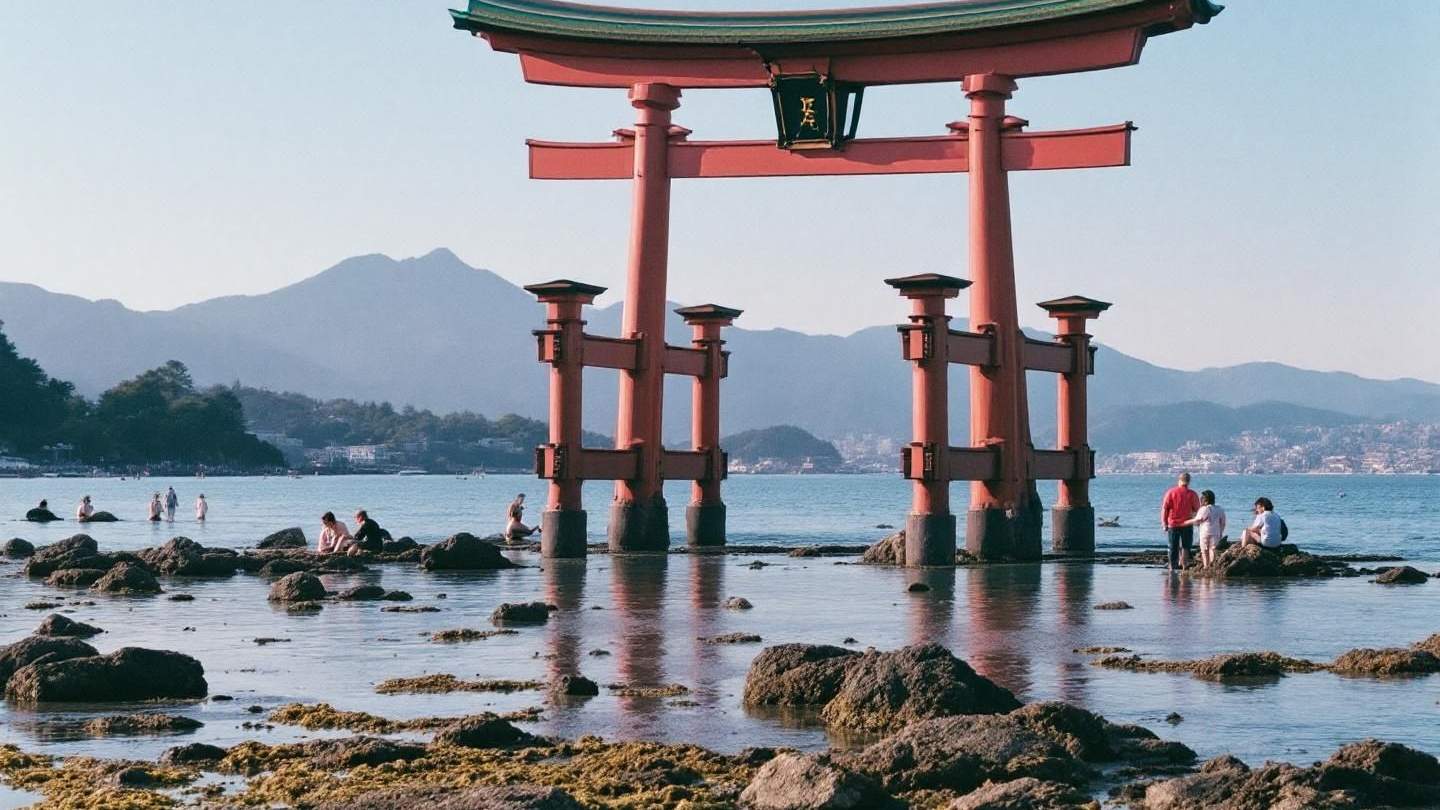
The great torii (大鳥居) of Itsukushima Shrine stands 16.6 meters tall in the shallows offshore from the shrine buildings. At high tide, the gate appears to float free of the sea, its reflection spreading across the water in morning light or evening gold. At low tide, the sea retreats to reveal the wide sandy flat around its base, and visitors walk out to touch the ancient camphor wood pillars.
The current gate is the eighth iteration, built in 1875 using camphor wood, and its weight — estimated at 60 tonnes — is what keeps it in place; it has no foundation piles driven into the seabed. The distinctive double-roof (ryobu torii) style, with secondary beams bracing the main pillars, is characteristic of Itsukushima Shrine architecture. The orange-red color is ofuna-beni, the traditional red pigment used across Shinto shrine architecture for its protective and purifying properties.
High Tide vs. Low Tide — Which Is Better?
Neither tide is definitively better; they offer different experiences and both have value. Understanding the difference helps you plan your time.
High tide: The torii appears to float on the water, which is the classic photographic image. The shrine buildings themselves, built on stilts over the tidal flats, are most atmospheric at high tide when water laps beneath the floorboards and the entire structure seems to hover. Approaching by ferry during high tide gives the most dramatic first impression of the island. The trade-off: you cannot walk to the torii.
Low tide: The tide retreats to reveal wide, grey-brown tidal flats around the gate’s base. You can walk directly to the gate across the sand and gravel and stand at its base — touching the pillars, looking up at the enormous scale of the structure, photographing from positions impossible at high tide. The shrine buildings at low tide lose some mystique but gain accessibility.
Practical recommendation: Plan to see the gate at both states if you can. Arriving in late morning at low tide lets you walk to the gate and explore the shrine without the worst crowds. Return in late afternoon as the tide rises for the floating gate effect, ideally coinciding with sunset (check tide tables and sunset time for your date). Tide tables for Miyajima are available at the ferry terminal and online at the JMA (Japan Meteorological Agency) website.
Best Times for Photography
The torii at dawn, with mist rising from the inland sea and no other tourists present, is sublime and achievable only by staying overnight on the island. The gate at dusk, lit orange by the setting sun, is possible on a same-day visit if you time your ferry arrival for early morning and your departure for after 6pm (late ferries run until approximately 10pm). The gate is illuminated after dark, which creates beautiful reflections but very different from the daytime photographs.
Itsukushima Shrine
Itsukushima Shrine (厳島神社) is among Japan’s most architecturally distinctive sacred sites, rivalling the great temples and shrines of Kyoto in historical significance. The main shrine buildings — including the haiden (hall of worship), main hall, and the famous covered corridor (kairō) — are built on wooden pylons that extend over the tidal flats, creating the impression of a structure suspended between sea and sky. The shrine was likely established in the 6th century, but the current layout was designed and built under the patronage of the powerful warlord Taira no Kiyomori in 1168.
Entry to the main shrine complex costs 300 yen and is straightforward — follow the covered wooden walkway from the ticket gate along the waterfront, through the halls, and out the other side. The route takes 20-30 minutes at a slow pace. The haiden faces the torii across the water; on a clear day at high tide with the gate floating ahead and the dark hills of the island behind, this view is genuinely breathtaking.
The Noh theater stage adjacent to the main hall is one of the oldest surviving Noh stages in Japan and hosts performances during major shrine festivals. Even outside performance dates it is worth pausing at — the floating stage over water is an extraordinary venue.
Visiting tips: The shrine is open daily from approximately 6:30am-6:30pm (hours vary by season; check the official website). Morning visits before 9am are transformative — the light is beautiful and the island belongs almost to you.
Mount Misen
Mount Misen (弥山, 535m) is the highest point on Miyajima and one of the most rewarding hikes in the Hiroshima region. The summit offers panoramic views across the Seto Inland Sea — dozens of small islands, cargo ships, fishing boats, and on clear days the coastline stretching toward Hiroshima in the north and Iwakuni in the south.
Hiking Routes
Three hiking trails ascend from different starting points near the shopping street area:
Omoto Trail (Omoto Course): The longest route at approximately 4.5km to the summit, ascending through dense cedar and oak forest with minimal exposure. Allow 2 hours up, 1.5 hours down. The trail is well-marked but steep in sections; hiking shoes are recommended.
Daisho-in Trail: Begins near Daisho-in Temple and is the most varied route, passing through forest, along ridges, and past the Reika-do (Eternal Flame Hall) near the summit. Approximately 3km, 1.5-2 hours up. The trail passes interesting rock formations and natural viewpoints.
Momijidani Trail: A shorter, somewhat steeper route through Momijidani Park, joining the main trail system about halfway up. Useful in combination with the ropeway.
The Ropeway
The Miyajima Ropeway (宮島ロープウェー) runs from the Momijidani valley to a point near the summit in two segments, with a connecting station at Kayatani. The full round-trip ticket costs 2,000 yen for adults. The ropeway operates approximately 9am-5pm (last ascent around 4:30pm); it closes for maintenance in January-February. Lines build up significantly between 10am-2pm on weekends., with a connecting station at Kayatani. The full round-trip ticket costs 2,000 yen for adults. The ropeway operates approximately 9am-5pm (last ascent around 4:30pm); it closes for maintenance in January-February. Lines build up significantly between 10am-2pm on weekends.
Recommended strategy: Take the ropeway up, walk to the actual summit (15 minutes from the upper ropeway station on a rocky path), enjoy the views, then hike down via the Daisho-in or Omoto trail. This combines the convenience of the ropeway with the satisfaction of a descent through the forest. Total time: 2-3 hours.
Summit Highlights
At the summit, the Reika-do hall contains a flame that is said to have burned continuously since Kobo Daishi lit it over 1,200 years ago — the same flame was used to light the Peace Flame in Hiroshima Peace Memorial Park. Sacred monkeys (Japanese macaques) inhabit the summit ridge area; they are wild animals, not tame, and food should not be offered or displayed.
Daisho-in Temple
Daisho-in (大聖院) is a Shingon Buddhist temple at the foot of Mount Misen, a 10-minute walk from the ferry pier. It is, in the opinion of many repeat visitors to Miyajima, the most interesting single site on the island after the torii.
The temple grounds are dense with Buddhist statuary, stone lanterns, prayer wheels, hanging votive tablets, and structures at various levels connected by steep stone staircases. Entry is free. The main hall houses a 1,000-year-old sacred fire (the Kanjō-no-Hi) lit from the same flame as the Reika-do on the summit. The Maniden Hall upstairs is lined with over 1,000 miniature Buddha statues, each holding a small lantern. The Henjokutsu cave beneath the main hall contains 88 sacred stones from temples across the Shikoku pilgrimage, allowing the complete pilgrimage to be symbolically walked in a few minutes.
Allow 45-60 minutes for Daisho-in. It is best visited in the morning before the crowds arrive from the 10am ferries.
Momijidani Park
Momijidani Park (紅葉谷公園) sits in a narrow wooded valley inland from the shopping street, named for the maple trees (momiji) that turn brilliant red and orange in late October and November. The park consists of a stream, stone bridges, pathways through maple and cherry groves, and a handful of small shrines and tea pavilions. In autumn it is genuinely spectacular and one of the best momiji viewing spots in the Hiroshima prefecture.
The park is free to enter and serves as the access route to the ropeway lower station. Even outside autumn it is a peaceful green space — cherry blossoms here in late March and early April are excellent, and the stream is pleasant in summer. Allow 20-30 minutes for a leisurely walk through.
Wild Deer
Miyajima’s wild deer are Sika deer (Cervus nippon), considered sacred messengers of the Shinto gods and protected from harm on the island for centuries. Today roughly 500 deer inhabit the island and roam entirely freely among the temples, shrine buildings, shopping streets, and ferry pier areas.
They are completely unafraid of humans and will approach very closely, particularly if they smell food. They are not aggressive but will bite, chew, and swallow paper items (maps, tickets, shopping bags, paper cups) in seconds. Keep paper and soft plastics out of reach — there is genuine joy in seeing a tourist’s carefully folded Hiroshima Peace Memorial pamphlet disappear into a deer’s mouth in 0.3 seconds, but less so when it is your own.
Do not feed the deer. The island authority actively discourages feeding because human food disrupts their diet and makes them more aggressive near humans. Photographing them is excellent — they are extraordinarily photogenic and will stand patiently within arm’s reach.
The Shopping Street (Omotesando)
The main shopping street (表参道商店街) runs from the ferry pier inland toward Itsukushima Shrine and is about 350 meters long, lined with souvenir shops, restaurants, and snack vendors on both sides. It is busy and commercial but the food options are genuinely good:
Oysters: Miyajima oysters (牡蠣, kaki) are large, briny, and fresh. They are served grilled in the half-shell (yaki-gaki) from vendors along the street — two or three oysters for around 500-800 yen is the standard offering. The grilled version develops a wonderful smoky, concentrated flavor. Oyster season peaks from October through April; quality is lower in summer months.
Momiji Manju: The signature confection of Miyajima — a small cake shaped like a maple leaf (momiji), typically filled with sweet red bean paste (anko). They are everywhere on the island, baked fresh in small shops with automated presses visible through the window. A pack of five or six costs around 500-700 yen. The anko filling is the classic; cream, chocolate, and matcha variants exist and are worth trying. Eat one warm from the baker — the texture is entirely different from a cooled, packaged version.
Kakifurai: Panko-breaded deep-fried oysters, served as a set with rice and miso soup for 1,200-1,800 yen at sit-down restaurants. A deeply satisfying lunch and one of the better things to eat on the island if you are staying for a full day.
Staying Overnight — Is It Worth It?
Yes, without qualification. Staying overnight on Miyajima transforms the experience. After the last day-tripper ferries leave in the mid-evening, the island belongs to the guests of its dozen ryokan and small hotels. The torii gate in silence at 7am, with the sun low and the sea still and no other person in sight, is one of the most peaceful moments available to a traveler in Japan.
The island has accommodation ranging from simple guesthouses (from around 8,000 yen per person including two meals) to high-end ryokan such as Iwaso Ryokan (from around 40,000 yen per person with full kaiseki dinner and breakfast). Mid-range options like Jukeiso and Miyajima Grand Hotel Arimoto offer good rooms with harbor views and traditional dinners for 15,000-25,000 yen per person, two meals included.
Overnight guests have access to the island from 5am. The shrine opens at 6:30am. The first day-trip ferry arrives around 8:30-9am. That 2-3 hour window in the early morning is the reason to stay.
Getting to Miyajima
From Hiroshima Station: Take the JR Sanyo Line or Hiroshima Electric Railway (streetcar) to Miyajimaguchi Station. The JR train takes about 25 minutes (240 yen); the streetcar takes about 65 minutes but costs only 240 yen and is a pleasant ride through the city. From Miyajimaguchi, walk 5 minutes to the ferry pier and take the Miyajima Ferry (10 minutes, 200 yen each way). Both JR and private (Matsudai Kisen) ferries run on the route; the JR ferry is covered by the Japan Rail Pass (saving 200 yen each way).
From central Hiroshima directly, there is also the Hiroshima Electric Railway (tram) route 2 that runs directly to Miyajimaguchi-Wharf — longer at 70 minutes but a single unbroken journey of 260 yen from central Hiroshima.
The ferry runs approximately every 15-20 minutes throughout the day, from roughly 6:25am to 10:15pm. The last ferry back to the mainland leaves Miyajima at approximately 10:22pm.
Getting Around the Island
Miyajima is navigable entirely on foot. The ferry pier, shopping street, Itsukushima Shrine, and Daisho-in are all within 10-15 minutes walk of each other. The ropeway station at Momijidani is 15 minutes walk from the pier. No cars operate on the main part of the island (there are restricted service vehicles only).
Carry water and wear appropriate footwear if hiking. The main paths near the shrine and shopping street are paved and flat; the mountain trails are unpaved, rocky in places, and require proper shoes.
Best Time to Visit
Autumn (late October to late November) is the single best time to visit Miyajima, combining the best weather, the momijidani maple colors, good oyster season, and relatively clear skies for views from Mount Misen. See the Japan in autumn guide for timing across the country. The crowds are large in late October-early November but manageable on weekdays.
Spring (late March to April) is excellent for cherry blossoms against the shrine buildings and torii. See the cherry blossom guide for timing across Japan. The combination of pink blossoms, orange gate, and green hills is exceptional.
Summer (July-August) is hot and very humid but the water views are beautiful and lantern festivals (including Kangen-sai in late July, a major shrine festival) are spectacular if timed correctly. Expect maximum crowds.
Winter (December-February) is cold (4-10°C) but very quiet. Early morning visits can be strikingly atmospheric. Snow occasionally falls on the island, and a snow-dusted torii gate in early morning is unforgettable.
Practical Tips
Arrive early. The single best advice for Miyajima. Take the first or second morning ferry (6:25am or 7:00am from Miyajimaguchi). You will have the island to yourself until around 9am.
Check tide times. Look up the Miyajima tide forecast before your visit and plan your arrival to coincide with either the tide you prefer, or arrange a long enough visit to see both. The Japan Meteorological Agency posts free tide tables.
JR Pass holders: The JR ferry is covered by your pass. Use it and save 400 yen round trip. The ferry docks at the same pier regardless of operator.
Luggage: Leave large bags at the coin lockers at Hiroshima Station rather than carrying them on the ferry. Miyajima is not luggage-friendly on the trails or in the narrow shopping street.
Deer and valuables: Keep maps, tickets, and bags closed and zipped. The deer have learned precisely where snacks are kept and will investigate bags with polite but persistent attention.
Temple/shrine etiquette: At Itsukushima Shrine, bow slightly before passing through the main torii. At Daisho-in, the prayer wheels (mani wheels) lining the staircase can be turned with your right hand as you walk — each rotation is said to equal one prayer. Footwear must be removed when entering the shrine buildings; pack socks.
Buying omiyage (souvenirs): Momiji manju, oyster crackers, and Hiroshima-related items are cheaper at shops in Hiroshima city than at Miyajima itself. Buy consumables for eating on the island; save bulk souvenir purchases for Hiroshima Station.
Miyajima is small, walkable, extraordinarily beautiful, and best experienced slowly. Give it a full day, or better yet a night.