Kyoto Tea Ceremony Experiences
Last updated: March 2026
The Japanese tea ceremony — known as chado (the way of tea) or chanoyu (hot water for tea) — is one of the most misunderstood experiences Kyoto offers to visitors. The short, tourist-oriented version that most people book does not convey the depth of what the practice actually is. But that does not make it not worth doing. A well-run tea ceremony experience in Kyoto, even a 45-minute introduction, gives you something genuine: a direct encounter with an aesthetic philosophy that has shaped Japanese architecture, garden design, poetry, ceramics, and the culture of hospitality for five hundred years.
This guide explains what a tea ceremony actually is, describes the different types of experiences available to visitors, lists the best venues with pricing, and tells you what to do, what to wear, and what to expect step by step.
What is the Tea Ceremony?
The tea ceremony is the ritualized preparation and presentation of matcha — powdered green tea — to guests, in accordance with principles developed by tea masters beginning in the 15th century. The practice reaches its philosophical peak in the teachings of Sen no Rikyu, who codified chado in the 16th century and whose aesthetic principles remain the foundation of all formal practice today.
The four core principles of chado are harmony (wa), respect (kei), purity (sei), and tranquility (jaku). These are not decorative ideas. They determine how the host moves, how the implements are arranged, when silence is kept, and how guests receive the tea. Every action in the ceremony — how the host lifts the tea bowl, the direction in which they wipe it, the sequence in which they clean each utensil — is deliberate and has a specific reason.
The tea ceremony is also inseparable from the aesthetic concept of wabi — an appreciation of impermanence, imperfection, and simplicity. The tea room, typically a small earthen-walled space with a bare scroll and a single flower arrangement, is designed to strip away the unnecessary. The tea implements are chosen not for their monetary value but for their quality of presence: a rough, hand-formed tea bowl that feels alive in the hands rather than a perfect porcelain piece.
Understanding these principles transforms even a brief encounter with the ceremony from a pleasant activity into something that continues to affect how you see Japan long after you leave. For broader cultural context, the Japan etiquette guide covers behavior in formal Japanese settings.
A Brief History
Tea arrived in Japan from China in the 8th century, but for centuries it was primarily a medicine and a luxury of the aristocracy. It was the Zen Buddhist monk Eisai who, returning from China in 1191, brought the method of grinding tea leaves into powder and whisking them with hot water. Zen temples quickly adopted this preparation method; the ceremony surrounding it developed in temple culture.
The aesthetic of the tea ceremony as we know it today developed during the Muromachi period (14th to 16th centuries) and reached its definitive form under Sen no Rikyu, tea master to the warlord Toyotomi Hideyoshi. Rikyu’s radical idea was that the tea ceremony should be about the connection between host and guest, stripped of status and display. He chose rough domestic ceramics over imported Chinese pieces. He built small, low-ceilinged tea rooms that forced even the most powerful nobles to bow to enter. He arranged flowers in a single bent stem from the garden rather than elaborate arrangements. Hideyoshi eventually ordered Rikyu to commit suicide — the reasons remain unclear — but his aesthetic ideas survived and define the practice today.
The three main schools of tea that descend from Rikyu’s family — Ura Senke, Omote Senke, and Mushanokoji Senke — are all headquartered in Kyoto. Ura Senke is the largest and most internationally active, and it is the school most likely to offer experiences to international visitors.
Types of Tea Ceremony Experiences
Not all tea ceremony experiences are the same. Understanding the different formats helps you choose one appropriate to your interest and time.
Casual Tourist Experience (30–45 minutes)
The most widely available format. You sit in a traditional room, a practitioner prepares a bowl of matcha for you and explains the basic procedure, you receive the bowl, rotate it before drinking (to avoid drinking from the “front” of the bowl), and you enjoy the accompanying wagashi sweet. There is usually brief commentary in English about the ceremony’s history.
These sessions are informal, accessible, and informative for visitors with no prior knowledge. They do not involve the full formal ceremony, which lasts several hours and requires extensive preparation. Cost: 1,500–3,500 yen per person.
Participatory Experience (60–90 minutes)
A longer format where you learn the basic movements yourself — how to receive the bowl, how to turn it, the correct posture for sitting on tatami, and sometimes how to make a bowl of matcha for another guest. Often takes place in a traditional machiya or temple garden. More personal than the basic tourist version. Cost: 3,000–6,000 yen per person.
Formal Demonstration by Certified Practitioners
Some venues, including tea school facilities, offer demonstrations of the full formal ceremony by senior practitioners. You observe rather than participate, but the level of execution and the quality of the setting are significantly higher. These are closer to the real experience and appropriate for visitors with a genuine interest in Japanese culture. Cost: 3,000–8,000 yen per person.
Private or Immersive Experience
Private sessions in traditional settings — a machiya with a private garden, a temple inner courtyard, a tea room in a historic ryokan — where the session is tailored to your interest and the atmosphere is significantly more intimate than a group venue. Sometimes combined with kimono rental, garden walks, or kaiseki meals. Cost: 8,000–20,000 yen per person.
Best Venues in Kyoto
En Tea Ceremony
Located near Yasaka Shrine in the heart of Gion, En offers one of the most convenient and well-run tourist tea experiences in the city. Sessions run throughout the day and last about 45 minutes. The setting is a traditional machiya townhouse with a small garden, and the practitioners speak enough English to provide clear context.
Cost: 2,000 yen per person for the standard session; 3,500 yen for the session with kimono rental. No advance booking required except in peak seasons. Walk-ins accepted if space is available.
Camellia Tea Experience
One of the most highly reviewed tea experiences in Kyoto, Camellia offers sessions inside a beautifully restored traditional house. The practitioners are trained tea ceremony teachers rather than staff hired for tourism, which makes a noticeable difference in the quality of execution. Sessions run 45–60 minutes and cover the history and philosophy of the ceremony in clear English.
Cost: 3,800 yen per person for the standard session. Advance booking strongly recommended. Located in the Karasuma area near downtown.
Urasenke Foundation
Ura Senke is one of the three great tea schools of Japan. The main school complex in northern Kyoto opens to public visitors on specific days and schedules. When available, attending a demonstration at the school itself — where student practitioners train under senior masters in the same courtyard used for centuries — is the most authentic version of the experience accessible to tourists.
Availability varies; check the school’s schedule well in advance. Demonstrations are not always offered in English. Cost when available: 1,000–2,000 yen donation suggested.
Ran Hotei
A boutique tea experience in the Nishiki area that offers private sessions for couples and small groups. The practitioner leads you through preparation of your own tea using the basic movements, with slow, patient instruction and attention to the philosophy behind each action. One of the better options if you want to leave with actual understanding rather than just a photograph.
Cost: 4,000–6,000 yen per person depending on format. Advance reservation required. Japanese-only instruction available with printed English explanations provided.
Ju-An Tea House at Urasenke
Separate from the main school, the Ju-An tea house offers public sessions in a garden setting designed specifically for visitors. The setting is exceptional — a traditional tea garden with stepping stones, lanterns, and a small tea house with a view of a raked gravel garden. Sessions are intimate and well-paced.
Cost: 3,500–5,000 yen per person. Advance booking required through the school’s visitor program.
Tea Ceremony at a Ryokan
If you are staying in a traditional ryokan, many include a tea ceremony or informal matcha service as part of the stay experience — sometimes in your room, sometimes in a private tea house on the property. This is often the most seamless way to experience tea ceremony as part of a broader Kyoto cultural immersion rather than as a standalone tick-box activity. The quality varies by property; top-tier ryokan like Tawaraya or Gion Hatanaka execute this with exceptional care.
What to Expect Step by Step
Understanding the sequence of a typical tourist tea ceremony removes anxiety and helps you engage more fully with what is happening.
Arrival and Seating
You will be asked to remove your shoes at the entrance. You will then be shown to a tatami room and guided to sit in seiza (kneeling on your heels) or cross-legged if that is uncomfortable. The host or practitioner will explain the basic etiquette before the ceremony begins.
The Sweet
Before the tea is served, you will receive a wagashi — a traditional Japanese confection made from sweet bean paste, often shaped and colored to reflect the current season. Cherry blossom shapes in spring, autumn leaf shapes in November. You eat this before the tea arrives, not with it. The sweetness of the wagashi prepares your palate for the slightly bitter matcha.
The Tea Bowl
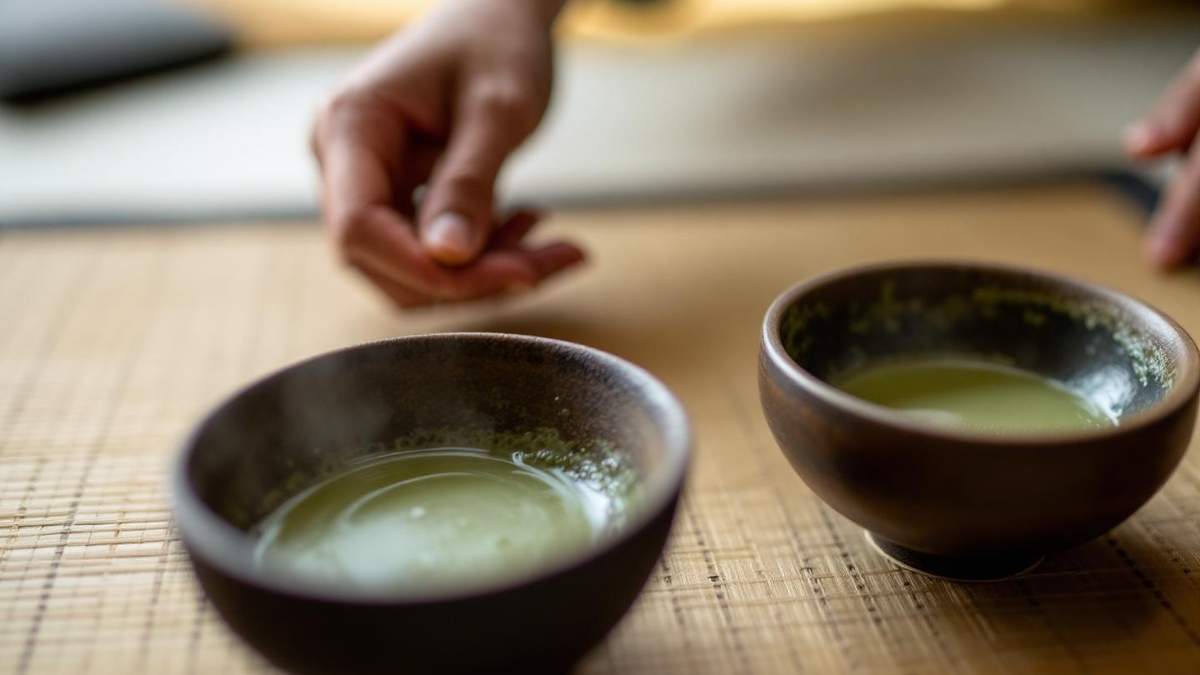
The host prepares your tea using specific movements — folding the tea cloth, scooping powdered matcha with a bamboo spoon, pouring hot water, whisking the matcha with a bamboo whisk (chasen) until a light foam forms on the surface. The bowl is placed in front of you.
Receiving the Bowl
Bow slightly before picking up the bowl. Lift it with both hands — right hand to take it, left hand to support the base. Before drinking, rotate the bowl two or three turns clockwise. This is to avoid drinking from the “front” — the side of the bowl facing you when it was placed down, considered its most beautiful side. By rotating, you show respect for the bowl and humility before the aesthetic.
Drinking the Tea
Drink in three to four sips. Slurping the last sip slightly is acceptable and shows you have finished. After drinking, wipe the rim of the bowl where your lips touched, using the edge of your hand or a provided cloth. Rotate the bowl back counter-clockwise before placing it down, returning its front face toward the host.
Appreciation
In a formal ceremony, the host may then offer the tea bowl for examination. You would pick it up, study its form, check the base, and make a brief comment about its beauty. In tourist settings, this step is usually simplified but the practitioner may still invite you to look at the bowl up close.
Questions
Most English-language sessions end with time for questions. This is worth using. Ask about the specific tea bowl (its age, maker, style), the season’s wagashi, or anything from the explanation that you want to understand more deeply.
Etiquette and Rules
Do not eat the wagashi with the tea. Eat it before the tea arrives. The sweet is specifically designed to come first.
Phones down. Taking a photograph of the space and the bowl before beginning is fine in tourist settings, but during the actual preparation and service, put your phone away. The practitioner’s movements deserve your full attention.
Sit still. Avoid shifting your position or moving around the room while the host is preparing the tea. The quietness of the room is part of the experience.
Express appreciation for the bowl. Even a brief comment — “The bowl is beautiful” — is appropriate and acknowledged. Tea ceremony culture places high value on guests’ attention to the objects used.
Avoid loud conversation during the ceremony itself. Questions come afterward.
What to Wear
There is no strict dress requirement for tourist tea ceremonies. However, a few guidelines improve the experience.
Avoid very short skirts or tight trousers — you will be sitting on tatami in seiza or cross-legged for an extended period and comfort matters. If you are wearing a kimono (which many visitors rent nearby), that is entirely appropriate and will be appreciated by the host.
Remove jewelry with sharp edges that might scratch the tatami or the tea implements. If you are participating in a session that involves handling the tea bowl, clean, dry hands are preferable.
Some more traditional venues will provide a brief instruction sheet at the entrance on conduct. Read it before entering.
Booking Tips
Book at least a few days in advance for any reputable venue, and weeks in advance during cherry blossom season (late March to early April), Golden Week (late April to early May), and autumn peak (mid-November). Popular sessions sell out.
Book directly where possible — the venue’s own website often has more up-to-date availability and may offer discounts over booking platform fees.
Consider private sessions if you are traveling as a couple or small group with genuine interest in the practice. The per-person cost is higher but the experience is incomparably more personal.
Manage expectations about the tourist format. A 45-minute introduction to tea ceremony will not reveal the full depth of a practice that takes decades to master. What it will give you is a genuine introduction, a direct sensory encounter with matcha and wagashi in the right setting, and enough context to understand why Japan’s greatest artists and thinkers considered this practice the highest expression of their aesthetic culture.
Beyond the Tea Ceremony
If the ceremony sparks genuine interest, Kyoto offers several ways to go deeper. See the full list of things to do in Kyoto for how to combine tea ceremony with other cultural experiences. The Omotesenke Fushin-an school occasionally offers multi-day workshops for serious visitors. Tea-themed kaiseki restaurants incorporate tea ceremony aesthetics into the full meal structure. The tea utensil shops along the shopping district near Nishiki Market sell everything from entry-level chasen whisks (800–2,000 yen) to museum-quality tea bowls by living masters (50,000 yen and above). Bringing home a tea bowl — selected in person from a specialist shop — is one of the finest souvenirs Japan offers.
Matcha in Kyoto Outside the Tea Ceremony
The tea ceremony experience is the most formal encounter with matcha, but Kyoto’s matcha culture extends well beyond the ceremony room and into daily street-level food.
Matcha sweets. The area around Kinkaku-ji and along the Philosopher’s Path has matcha specialty shops selling matcha soft serve ice cream (400–600 yen), matcha parfaits layered with red bean, jelly, mochi and ice cream (1,200–1,600 yen), and matcha chocolate in seasonal forms. The chain Itohkyuemon from Uji has several Kyoto locations and maintains high ingredient quality.
Matcha cafes. Several dedicated matcha cafes operate in the Gion and Higashiyama areas, serving a range of matcha preparations from thin tea (usucha, the standard ceremony version) to thick tea (koicha, the strong, almost paste-like version used in advanced ceremony practice) alongside traditional sweets. Kissa Juraku and En cafe near Yasaka Shrine are both well-regarded.
Nishiki Market. The market has multiple vendors offering fresh matcha in different grades. Buy ceremonial-grade (usucha) matcha for use at home — Kyoto matcha as a souvenir has a strong shelf life and transports easily. A 30g tin of quality ceremonial matcha from a Nishiki vendor runs 1,500–4,000 yen depending on grade.
Uji day trip. The matcha capital proper is Uji, 17 minutes by JR from Kyoto Station. The main street from Uji Station to Byodoin Temple is lined with tea merchants, farms, and cafes — a half-day dedicated to matcha tasting alongside the UNESCO-listed temple makes the most of the short distance from Kyoto.
Seasonal Tea Ceremony Events
Kyoto’s tea ceremony culture intensifies during the city’s great seasonal moments.
Spring. During cherry blossom season, several tea schools and gardens offer outdoor tea service beneath blooming trees. Heian Shrine’s garden tea service and the outdoor sessions at Kodai-ji are both available with advance booking.
Gion Matsuri. During Kyoto’s July festival, tea ceremony demonstrations and public tea service occur in the gardens of temples along the Higashiyama district. Check the event calendar for the specific venues and dates each year.
Autumn. November tea ceremonies often incorporate autumn foliage viewing — the combination of watching maple trees turn red through a shoji screen while drinking a bowl of matcha represents the wabi aesthetic at its most complete. Several venues offer this as a specific seasonal program in mid-November.
Tea ceremony competitions. The All Japan Tea Ceremony Competition is held in Kyoto annually and is occasionally open to public viewing. Check the Ura Senke school’s event calendar for the current year’s schedule.