Kamakura
Complete Kamakura travel guide. Visit the Great Buddha, explore ancient temples, hike between shrines, and enjoy the coastal atmosphere south of Tokyo.
Quick Facts
- Best For
- Temples, Hiking, Beaches
- Days Needed
- 1 full day
- Best Season
- Spring and Autumn
- Getting There
- 1h from Tokyo (JR)
- Getting Around
- Walking + Enoden train
- Budget (per day)
- 3,000-8,000 yen
Why Visit Kamakura
For 150 years between 1185 and 1333, Kamakura was the seat of Japan’s first samurai government — the Kamakura Shogunate. Before Tokyo, before even the great medieval expansion of Kyoto, this seaside town nestled between forested hills and Sagami Bay was where the warrior class that would dominate Japanese society for seven centuries chose to plant its center of power. The temples, shrines, and stone Buddhas they built are still here, and they are among the most affecting historical sites in the country.
Today, Kamakura has settled into a second identity as one of Tokyo’s most beloved day-trip destinations — a place where urbanites come to walk hiking trails between medieval temples, eat lunch on a terrace overlooking the sea, and take the Enoden tram along the coast as it squeezes between houses and surf shops with the Pacific glittering alongside. The combination of history, nature, and a certain laid-back coastal character gives Kamakura a personality unlike anywhere else in the greater Tokyo area.
The city is also compact enough that one well-planned day is genuinely satisfying. Start early, follow the hiking trail between temples, save Kotoku-in Great Buddha for late morning, take the Enoden for the afternoon, and finish with sunset from Enoshima. You will have covered the essential Kamakura. See Tokyo day trips for how to combine Kamakura with other destinations.
Getting to Kamakura
JR Yokosuka Line from Tokyo Station, Shinagawa, or Shibuya (via the Shonan-Shinjuku Line) runs directly to Kamakura Station. Journey time is about 55 minutes from Tokyo Station, 50 minutes from Shinagawa. The fare is 940 yen from Tokyo and is covered by the JR Pass.
Rapid trains run approximately every 15–20 minutes. No special booking required — simply board.
Tip for JR Pass holders: The JR Pass does not cover the Enoden tram, which runs along the coast from Kamakura to Fujisawa. You will need a separate Enoden ticket or an Enoden day pass.
Tsurugaoka Hachimangu
The central shrine of Kamakura. Tsurugaoka Hachimangu was founded in 1063 and relocated to its current site by Yoritomo Minamoto in 1180, positioned at the top of a gently rising approach that bisects the historic center of the city. The approach — Wakamiya Oji — is lined with cherry trees for over two kilometers, making it the best cherry blossom street in the Kanto region outside of Tokyo.
The shrine is dedicated to Hachiman, the Shinto god of archery and war, a fitting patron for a samurai capital. The main shrine buildings at the top of the stone staircase are brightly painted red and commanding; the museum to the left of the main steps (Kokuhokan treasure hall) displays important wooden Buddhist sculptures from Kamakura’s medieval temples. Entry to the shrine grounds is free; museum entry is 200 yen.
The large ginkgo tree that stood beside the main staircase — famous for its autumn yellow and its association with a 12th-century assassination — fell in a storm in 2010, but a smaller shoot from its roots is growing back. The absence of the great tree is still noticeable if you know to look for it.
Practical note: The shrine is busiest on weekends and during major festivals. The Reitaisai Grand Festival in mid-September includes traditional horseback archery (yabusame) along the main approach — worth planning around if your schedule allows.
The Great Buddha: Kotoku-in
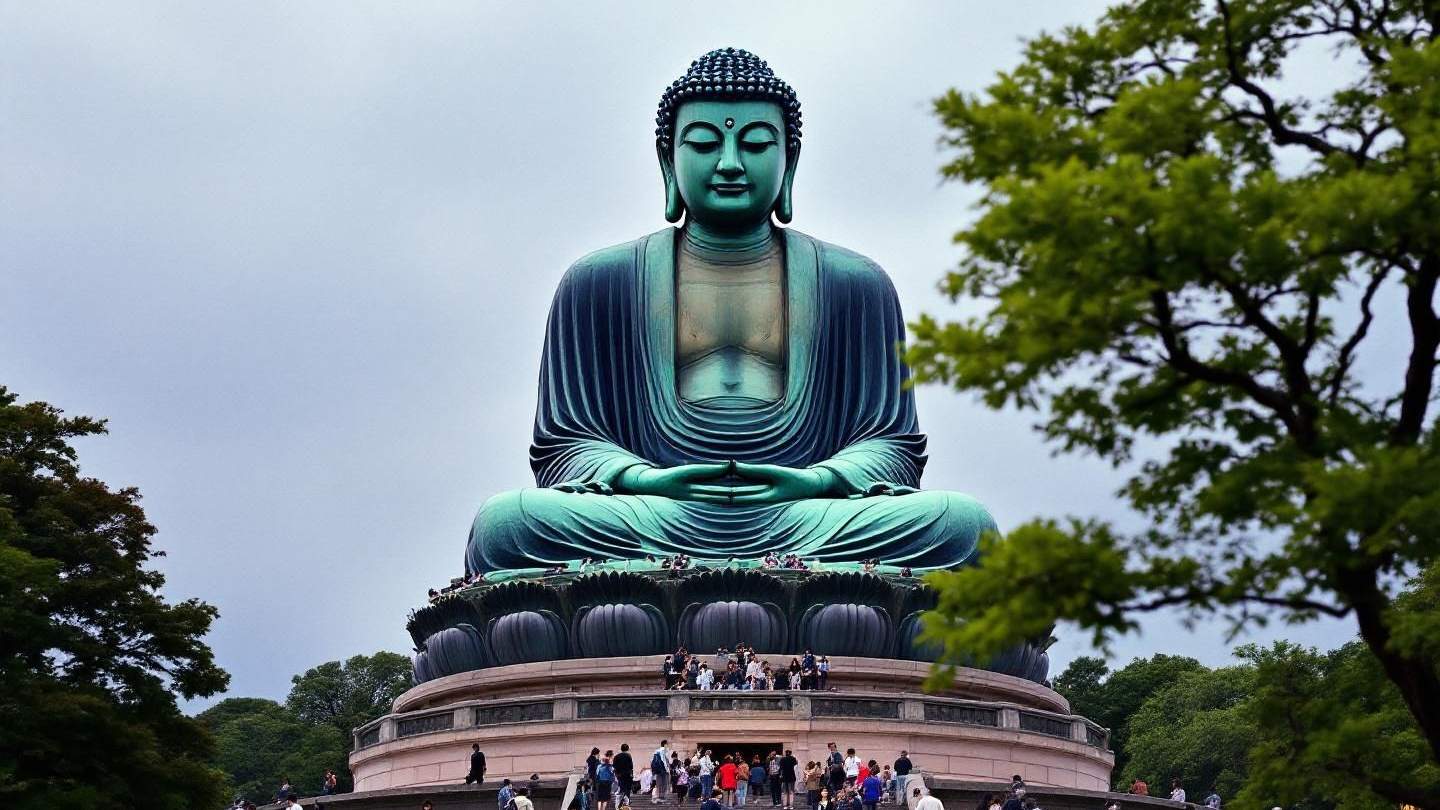
The Kotoku-in Great Buddha (Kamakura Daibutsu) is the defining image of Kamakura and one of the most recognizable sculptures in Japan. The bronze Amida Buddha statue was cast in 1252, stands 11.3 meters tall (13.35 meters including the base), and weighs approximately 121 tonnes. It has sat in the open air since the 15th century, when a tsunami destroyed the wooden hall that originally enclosed it.
What makes the Kamakura Buddha compelling beyond its scale is its expression. While Todai-ji’s Great Buddha in Nara dominates through sheer size and grandeur, Kamakura’s is more intimate. The seated posture is composed and slightly forward, the hands resting in the cosmic mudra of meditation, and the face carries a quality of profound serenity that reads clearly from a distance. It is a meditative figure rather than an imperial one.
You can enter the interior of the statue through small doors in the sides (entry fee to the interior is 50 yen extra, on top of the standard 300 yen entry to the grounds). Inside, you see the hollow bronze casting and the structural supports added over the centuries. It is a slightly surreal experience — standing inside the abdomen of a 700-year-old statue — and worthwhile for the craftwork visible in the interior walls.
Entry: 300 yen for adults (50 yen extra for interior). Open 8am–5:30pm (April–September), 8am–5pm (October–March).
Getting there from Kamakura Station: About a 25-minute walk along Komachi-dori and then west, or a short bus ride (routes 4 or 7 from the bus terminal outside the east exit).
Hasedera Temple
Hasedera is one of Kamakura’s most beautiful and most visited temples, situated on a hillside above the Great Buddha approach road. The main hall enshrines a gilt wooden statue of the eleven-faced Kannon (Juichimen Kannon), standing 9.18 meters tall — one of the largest wooden statues in Japan, carved in the 8th century from a single camphor tree according to tradition.
The temple grounds are exceptional. A cave carved into the hillside contains hundreds of small stone Jizo figures, left by families who have experienced miscarriage, stillbirth, or child loss — an ancient tradition that continues actively today. The atmosphere in the cave is quiet and profound. An upper garden overlooks the coast and, on clear days, the Pacific horizon.
The viewing platform from the upper level gives one of the best sea views in Kamakura. In June and July, the hydrangeas on the hillside paths bloom in cascading blues and purples — Hasedera becomes one of the most photographed spots in the Kanto region during this season.
Entry: 400 yen. Open 8am–5:30pm (March–September), 8am–5pm (October–February). Expect queues for the cave section on weekend mornings.
Hokoku-ji: The Bamboo Temple
Hokoku-ji is the temple to visit when you want to escape the main tourist circuit. Located in the quieter eastern part of Kamakura (a 15-minute bus ride or 25-minute walk from the station), this Rinzai Zen temple is known for its bamboo grove — a stand of thick-culmed moso bamboo behind the main temple buildings, walkable on a stone path for an admission of 300 yen.
The bamboo grove is not as large as Arashiyama in Kyoto, but it is dramatically less crowded, and the scale — tall straight culms filtering the light into green and gold — is entirely satisfying. There is a tea house within the grove where you can sit with a cup of matcha (500 yen including bamboo grove entry) and experience the bamboo at its most atmospheric: quiet, rustling, and complete.
The main temple buildings are also beautiful, with a particularly well-maintained meditation hall. The temple dates from 1334.
Zeniarai Benzaiten
One of Kamakura’s most enduring folk traditions: the Zeniarai Benzaiten shrine, tucked into a rocky cleft in a hillside in western Kamakura and reached through a narrow tunnel carved through the rock. The shrine is dedicated to Benzaiten, the goddess of fortune and music, and at its heart is a spring where worshippers wash their coins and banknotes, believing the water will multiply their money.
The ritual is taken seriously by regular visitors. The cave with the spring is always fragrant with incense and the baskets for washing money are always in use. The atmosphere — dark, smoky, intimate — is unique among Kamakura’s religious sites, more folk magic than formal religion.
Entry is free. Access is via a short but atmospheric tunnel cut through the cliff face. The shrine is about a 15-minute walk west of Kamakura Station or accessible by bus.
Enno-ji Temple
A lesser-visited gem near Kamakura Station, Enno-ji is a small temple containing wooden statues of the judges of hell (Emma-O and his ten subordinate judges) that are among the finest medieval sculptures in Kamakura. The statues are displayed in an open wooden hall and can be viewed up close — an unusual intimacy for museum-quality works. Entry is 200 yen. Takes about 15 minutes.
Hiking Between Temples: The Tenen Trail
Kamakura’s forested hills conceal a network of hiking trails that connect the major temples and shrines. The best and most accessible is the Tenen Trail (Tenenko Trail), a one-way route of about 4 kilometers that runs from Kencho-ji (one of Kamakura’s great Zen temples, 500 yen entry) over the forested ridge to emerge at Zuisen-ji temple in the east.
The route: Enter Kencho-ji and continue past the main buildings to the rear of the complex, where a stone path leads steeply up into the forest. The trail climbs to a ridge with views over both sides of the hills — city and ocean on one side, forested valleys on the other — before descending gradually through cedar and oak forest to Zuisen-ji. Allow 2–2.5 hours including rest stops.
The trail requires reasonable fitness (the initial climb from Kencho-ji is steep and uneven) but no specialist equipment beyond comfortable walking shoes. In autumn, the ridge forest turns bronze and red and the views are spectacular.
Kencho-ji deserves at least 30 minutes on its own. Founded in 1253, it is the first among Kamakura’s five great Zen temples (the Gozan) and contains important architecture including the original temple bell (a National Treasure), a juniper tree said to have been planted from Chinese seeds brought by the temple’s founder, and zen meditation halls still in active use.
Komachi-dori Shopping Street
The covered shopping street running north from Kamakura Station toward Tsurugaoka Hachimangu is the commercial artery of tourist Kamakura. It is unashamedly touristy and also genuinely enjoyable. Shops sell local specialties — yuzu (citrus) products, hato sable cookies (dove-shaped butter biscuits that have been Kamakura’s signature souvenir since 1897), handmade jewelry, surfwear, ceramics, and traditional crafts.
The street is best walked early in the morning (before 9am) when it is quiet, or in the late afternoon when the light softens. Midday on a weekend it can be shoulder-to-shoulder.
The Enoden Railway and the Coast
The Enoshima Electric Railway (Enoden) runs 10 kilometers from Kamakura Station to Fujisawa Station along the coast, stopping at 15 stations. A day pass costs 800 yen. The line is over a century old and the single-car trams run through streets so narrow that the pantograph nearly clips the buildings on either side — a uniquely intimate tram experience.
Yuigahama Beach and Zaimokuza Beach are visible from the tram and accessible from stops on the eastern section of the line. Kamakura’s beaches are popular with Tokyo surfers and summer swimmers but are relatively calm in spring and autumn. The coastal restaurants near Yuigahama serve excellent fresh seafood.
Kamakura-koen and Inamuragasaki: At the southern tip of the Kamakura coast, Inamuragasaki is a small headland with views toward Enoshima and, on clear days, Mount Fuji. The Enoden stop here is a popular spot for watching sunsets.
Enoshima Island
Enoshima is accessible as an extension of the Kamakura day, a 30-minute ride on the Enoden from Kamakura Station to Enoshima Station (or Katase-Enoshima on the Odakyu line). A bridge connects the island to the mainland.
The island is home to Enoshima Shrine, a series of sea caves, a medieval lighthouse, and a pleasant pedestrian street lined with restaurants serving fresh seafood — the grilled shirasu (whitebait) rice bowl is the local specialty, around 1,200–1,500 yen.
The climb through the shrine complex to the top of the island takes about 20 minutes and involves a series of escalators (300 yen for a pass) or stairs. The ocean garden at the top is pleasant and the views of Mount Fuji on clear days are good.
Enoshima adds about two hours to the day if you include travel time.
Local Food
Hato Sable: The quintessential Kamakura souvenir. These dove-shaped butter cookies from Toshimaya confectionery have been made since 1897 and are genuinely excellent — buttery, crisp, with a clean vanilla flavor. A box of 10 costs around 900 yen. The main shop is on Komachi-dori.
Shirasu: Fresh whitebait (shirasu) is fished in Sagami Bay and is a Kamakura specialty. Shirasu don (whitebait rice bowl) is served with either raw or semi-dried whitebait over seasoned rice. It is light, oceanic, and one of the better rice dishes in the region. Most beach-area restaurants and several spots on Komachi-dori serve it. Cost: 1,000–1,500 yen.
Matcha sweets: Several good matcha cafes and sweet shops along Komachi-dori serve matcha parfaits, warabi mochi, and matcha soft-serve ice cream. Expect to pay 600–900 yen for a matcha dessert.
Best Time to Visit
Spring (late March to early April): Cherry blossoms along Wakamiya Oji and at Tsurugaoka Hachimangu are spectacular. Extremely crowded on peak blossom weekends — visit on a weekday if possible.
June to July: Hydrangea season, particularly beautiful at Hasedera and along the Enoden tram route. Less crowded than spring.
September to November: Autumn foliage and comfortable temperatures. Clear days in October often give Mount Fuji views from the coast.
Summer: The beaches bring crowds from Tokyo in July and August. Temple areas are hot and busy. Surf culture is lively along the Enoden coast.
Winter: The quietest season. Cold but rarely harsh. Good Fuji views from the coast. The Great Buddha in winter morning light is particularly atmospheric.
Practical Tips
IC card: An IC card (Suica or Pasmo) works on JR and the Enoden. Load it up before leaving Tokyo.
Temple pass: Kamakura does not offer a comprehensive temple pass, so budget for individual entries. Core temples for a full day: Tsurugaoka Hachimangu (free), Kotoku-in (300 yen), Hasedera (400 yen), Kencho-ji (500 yen), Hokoku-ji (300 yen). Total around 1,500 yen.
Crowds at weekends: Kamakura is popular enough that summer and spring weekends feel genuinely overcrowded around Komachi-dori and the Great Buddha. A weekday visit in spring or autumn is significantly more enjoyable.
Sequence matters: Start at Tsurugaoka Hachimangu when it opens (often 8am), walk west toward the Great Buddha, then take the Enoden east for the afternoon. For context on Nikko as an alternative day trip from the capital, see the Tokyo day trips guide. This means you hit the busiest sites in the morning before tour groups arrive and have a relaxed afternoon on the coast.
Luggage: Kamakura Station has coin lockers for day-trippers. Use them — you do not want to carry a large bag up the hiking trail.