Best Things to Do in Hakone
Last updated: March 2026
Hakone is the destination Tokyoites escape to when they need mountains, hot springs, clean air, and the chance to see Mount Fuji framed perfectly above a mountain lake. Situated in the Fuji-Hakone-Izu National Park, about 80 kilometers southwest of Tokyo, Hakone offers a density of experiences uncommon for an area of its size: volcanic scenery, world-class contemporary art museums, a caldera lake with a pirate ship, a ropeways that passes directly over steaming sulfur vents, historic hot spring towns, and some of Japan’s finest ryokan.
Most visitors come for one or two nights. This is the right call — Hakone rewards slow movement, and the full Hakone Loop (a circular route combining train, cable car, ropeway, lake cruise, and bus back to the starting point) is one of Japan’s most satisfying travel experiences when executed without rushing.
Quick Reference
| Activity | Time Needed | Cost | Best For |
|---|---|---|---|
| The Hakone Loop | Full day | Hakone Free Pass from 6,500 yen | First-time visitors |
| Onsen soak at a ryokan | Evening / morning | Varies by property (day use from 1,000 yen) | Relaxation |
| Hakone Open Air Museum | 2–3 hours | 1,600 yen | Art, families |
| Lake Ashi cruise (Pirate Ship) | 30–40 minutes | 1,200 yen one way | Views, photography |
| Hakone Ropeway over Owakudani | 20–30 minutes | 1,500 yen one way | Volcanic scenery |
| Owakudani Volcanic Valley | 45–60 minutes | Free to walk (ropeway fare) | Geology, black eggs |
| Hakone Shrine (Mototsumiya) | 30–45 minutes | Free | Lakeside torii gate |
| Pola Museum of Art | 2–3 hours | 1,800 yen | Art lovers |
| Yumoto Onsen Town walk | 1–2 hours | Free (walking) | Hot spring atmosphere |
| Amazake-chaya historic teahouse | 30 minutes | Cost of tea/food | History, quiet |
The Hakone Loop
The Hakone Loop is the backbone of any Hakone visit — a circular route using five different forms of transportation that passes through the region’s best scenery while depositing you at the major attractions. The Hakone Free Pass (6,500 yen from Shinjuku, 5,000 yen from Odawara) covers all transportation within the loop including the Romancecar limited express from Shinjuku and provides discounts at dozens of attractions and restaurants.
The standard loop runs: Odawara or Shinjuku → Hakone-Yumoto (by Romancecar or Odakyu Line) → Gora (by Hakone Tozan Railway switchback train) → Sounzan (by cable car) → Togendai (by ropeway over Owakudani) → Motohasune or Hakonemachi (by Lake Ashi cruise) → back to Odawara (by highway bus or Tokaido highway). The entire loop without stopping for anything takes about 3.5 hours. Allow a full day if you want time at each stop.
The Hakone Tozan Railway is the oldest mountain railway in Japan (opened 1888) and one of the steepest in the country, using switchbacks to climb the mountain in three-point turns. It runs through hydrangea fields in June and early July that are spectacular from the train windows.
Onsen
Hot springs are the reason Hakone has attracted visitors since the Edo period, when the town of Yumoto served travelers on the old Tokaido highway. The region has numerous onsen towns, each fed by different mineral springs with different properties.
Hakone-Yumoto is the main onsen town and the most accessible — a short walk from the train station, with many hotels and ryokan offering day-use onsen (hibiyu, from around 1,000–3,000 yen) for visitors not staying overnight. The water here is alkaline and gentle on skin.
Gora and the surrounding mountain area have higher-altitude, more isolated hot spring inns. Staying at a ryokan with a private open-air bath (rotenburo) overlooking the mountains is one of Hakone’s defining luxury experiences.
The Tenzan Tohji-kyo spa facility in Yumoto (1,300 yen admission) offers multiple indoor and outdoor baths in a natural forest setting and is an excellent option for visitors without ryokan accommodation. Towels available for rent.
For visitors with tattoos, note that many onsen in Japan prohibit tattooed guests. Hakone has several tattoo-friendly facilities — check before booking. The onsen and tattoo guide has full details.
Hakone Open Air Museum
The Hakone Open Air Museum (admission 1,600 yen) is one of Japan’s finest sculpture parks — 70,000 square meters of hillside garden displaying over 120 outdoor sculptures alongside five indoor galleries. The collection is genuinely excellent: a dedicated Picasso pavilion holds 300 works, and outdoor pieces range from Henry Moore bronzes to Niki de Saint Phalle’s stained glass tower (which visitors can enter).
The combination of high-quality art and mountain scenery is unusual even by world standards. The museum is very family-friendly, with climbing structures integrated among the sculptures, a children’s playground, and several restaurants. Allow two to three hours for a proper visit.
Located directly on the Hakone Tozan Railway line (Chokoku-no-Mori Station), it integrates naturally into the Hakone Loop.
Owakudani Volcanic Valley
Owakudani (roughly “Great Boiling Valley”) is an active volcanic zone formed by the eruption of Mount Hakone approximately 3,000 years ago. The area steams dramatically from dozens of fumaroles, the sulfur smell is pervasive, and the landscape has the surreal quality of a place where geology is visibly ongoing.
The main attraction beyond the scenery is the kuro-tamago — hard-boiled eggs cooked in the black sulfurous hot spring water, which turns the shells black. The legend holds that eating one black egg adds seven years to your life; eating two adds fourteen. They are sold in packs of five for 500 yen and taste, essentially, like hard-boiled eggs. The atmosphere of eating them while volcanic steam rises around you is the point.
Note: Owakudani’s ropeway access is occasionally closed due to volcanic activity (sulfur gas levels). Always check current status before visiting — the Hakone Ropeway website posts real-time information. Alternative lake cruise routes exist that bypass the valley if it is closed.
Lake Ashi and the Pirate Ship
Lake Ashi (Ashinoko) is a crater lake in the caldera of the ancient Hakone volcano, fed by spring water and framed on clear days by Mount Fuji rising to the north. On mornings with low humidity and no clouds — most common in autumn and winter — the reflection of Fuji in the lake is one of Japan’s most photographed views.
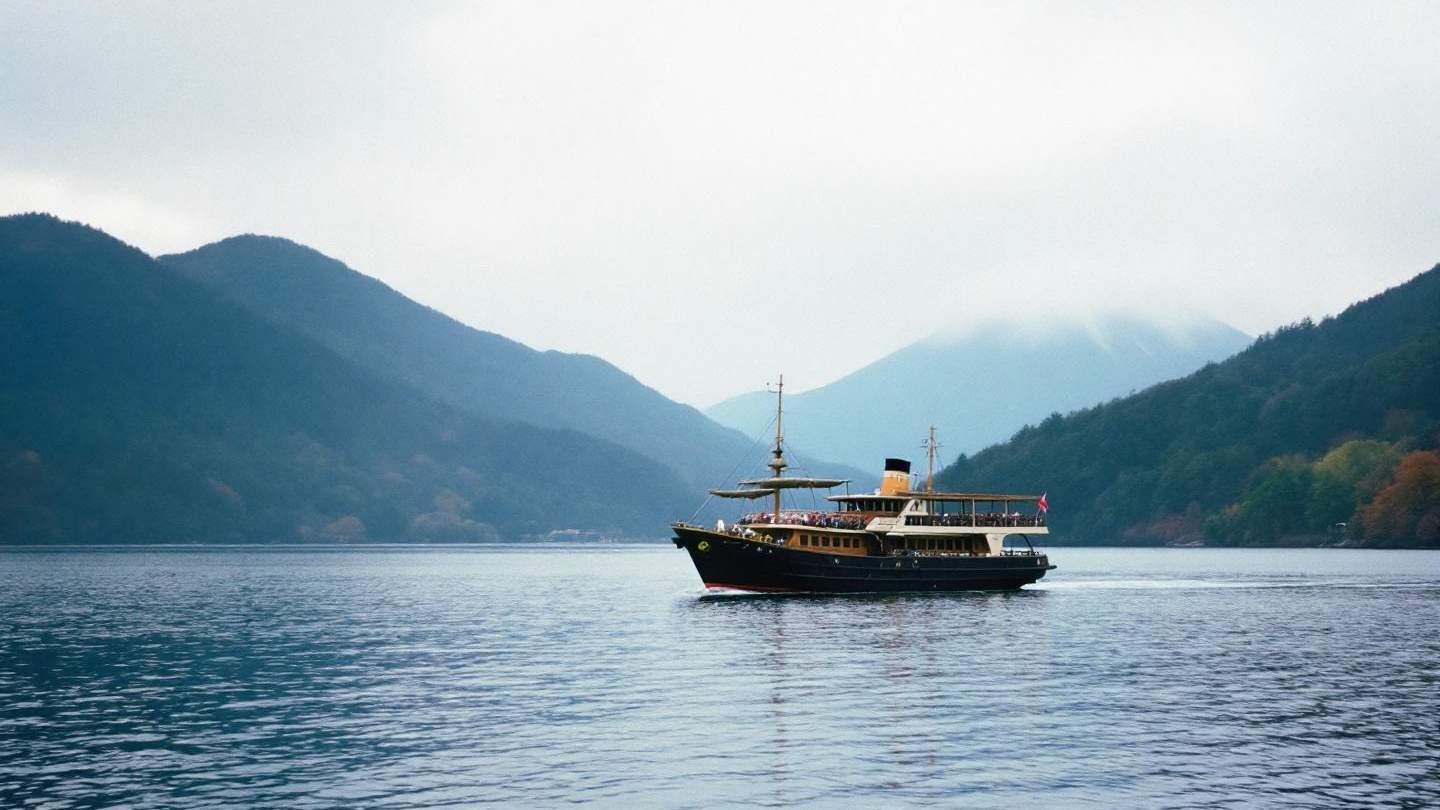
The lake is traversed by the famous Hakone Sightseeing Cruise ships, which are designed to look like 17th-century galleon-style vessels and marketed as “pirate ships.” This description is slightly embarrassing to recite and completely accurate to the experience. The ships are large, colorful, and memorable, and the views from the upper deck across the lake to Fuji (weather permitting) are excellent. Fares are 1,200 yen one way or included in the Hakone Free Pass.
Hakone Shrine (free) sits on the lakeside at Motohasune and has a famous red torii gate that stands in the water — visible from the lake cruise and accessible for close-up photography from the pier. The shrine itself is set within cryptomeria forest on the hillside above the lake and is a proper working shrine with a quiet, dignified atmosphere despite its photogenic reputation.
Pola Museum of Art
The Pola Museum of Art (admission 1,800 yen) is one of Japan’s best private art museums — a collection of approximately 9,500 works displayed in a sensitively designed building integrated into the Hakone forest. The permanent collection covers Impressionism through early 20th-century European art (Monet, Renoir, Picasso, Matisse alongside Cézanne) as well as a significant Japanese oil painting collection.
The building itself is worth the visit: designed by architect Nishizawa Ryu to minimize visual impact on the forest, with long corridors of glass looking into the trees and natural light calibrated carefully throughout the galleries. The surrounding forest walk is freely accessible.
Located in the Sengokuhara area and not directly on the Hakone Loop route, the Pola Museum requires a taxi (~2,000 yen from Gora) or bus (Hakone Tozan Bus) to reach. Allow 2–3 hours and plan it as either a morning destination before the loop or an afternoon diversion.
Mount Fuji Views
Hakone’s primary draw for many visitors is the possibility of seeing Mount Fuji — and this requires managing expectations. Fuji is visible from Hakone on clear days from October through early May, when the atmosphere is dryest. During summer (June–September), humidity and clouds typically obscure the mountain on most days.
The best viewing points within Hakone:
- Lake Ashi (from the shore or cruise ship deck) — classic Fuji-reflected-in-water view
- Mototsumiya (Hakone Shrine’s mountain sanctuary, 1-hour hike from the lake) — panoramic view
- Hakone Ropeway — views of Fuji from above the valley on clear days
- Sengokuhara Susuki Fields — in autumn (October–November), tall silver grass with Fuji behind is spectacular
For visitors specifically focused on Mount Fuji, the Mount Fuji Guide covers the full range of viewing and climbing options. Hakone provides excellent Fuji views without the crowds of the Fuji Five Lakes area.
Best Time to Visit Hakone
| Season | Conditions | Highlights | Crowds |
|---|---|---|---|
| Spring (Mar–May) | 8–20°C, pleasant | Cherry blossoms in Yumoto, spring wildflowers | Moderate to high in April |
| Summer (Jun–Aug) | 20–30°C, humid | Hydrangeas along Tozan Railway (June–July) | High; Fuji usually not visible |
| Autumn (Sep–Nov) | 10–22°C, best clarity | Autumn foliage, silver grass fields, best Fuji views | High in October–November |
| Winter (Dec–Feb) | 0–10°C, cold | Clearest Fuji views, snow on mountains, uncrowded onsen | Lower crowds; excellent for ryokan stays |
Autumn (mid-October to late November) offers the combination of foliage color, cool temperatures ideal for outdoor exploration, and the clearest Fuji views of the year. Winter is the best season for guaranteed Fuji visibility and the most atmospheric onsen experience.
How to Get to Hakone
| Route | Travel Time | Cost | Notes |
|---|---|---|---|
| Romancecar (Odakyu) from Shinjuku to Hakone-Yumoto | 85 minutes direct | ~2,300 yen + 900 yen Romancecar surcharge | Most comfortable; scenic; included in Hakone Free Pass |
| Odakyu Line (local/express) from Shinjuku to Odawara, then transfer | 90–110 minutes | ~1,500 yen | Budget option; Free Pass covers from Odawara |
| Shinkansen (Kodama) from Tokyo to Odawara | 35 minutes | ~3,000 yen | Fastest to Odawara; then Hakone Tozan train |
| Highway bus from Shinjuku Busta | 2 hours | 2,060 yen | Affordable; drops at multiple Hakone stops |
The Hakone Free Pass (2-day: 6,500 yen from Shinjuku, 5,000 yen from Odawara; 3-day versions available) is almost always the most economical option for visitors planning to use multiple transport modes. It covers the Romancecar and all transportation within the loop. See the full Day Trips from Tokyo guide for more on logistics.
Practical Tips
Book ryokan in advance. Hakone’s best hot spring inns — particularly those with private outdoor baths and good Fuji views — book out months ahead during autumn foliage season and Golden Week (late April to early May). For first-time visitors, staying a single night at a ryokan is strongly recommended even on a tight budget; the overnight experience of the hot springs, kaiseki dinner, and mountain morning is central to what Hakone actually offers.
Weather uncertainty is real. Mount Fuji is not visible on most summer days and on many overcast days year-round. Check the weather forecast before your visit and consider a flexible itinerary that does not depend entirely on a Fuji sighting.
The Hakone Loop can be reversed. Starting from the lake end (arriving by highway bus direct to Hakonemachi) and finishing at Yumoto allows you to experience the ropeway and cable car later in the day when the morning haze has sometimes lifted. Both directions work well.
Owakudani closures happen with some frequency due to volcanic gas warnings. Always check the Hakone Ropeway website the morning before your visit if Owakudani is on your itinerary.
For a structured Tokyo day-trip plan, the Day Trips from Tokyo guide includes Hakone alongside Kamakura and Nikko with timing options for each.
Hakone Food and Local Specialties
Hakone’s food identity is shaped by the mountain altitude, the volcanic landscape, and the kaiseki tradition of the ryokan culture. Beyond the famous black eggs of Owakudani, the region has distinctive local products worth seeking out.
Yuba (tofu skin, skimmed from soy milk during tofu production) is Hakone’s most recognized local food specialty, particularly in the Yumoto area. Several restaurants serve yuba in multiple preparations — raw sheets in dipping broth, incorporated into soup, or dried and used as a noodle substitute. A yuba lunch set at a specialist restaurant costs around 1,200–2,000 yen.
Hakone Craft Beer: The small-batch brewery scene in Hakone has expanded in recent years. Swan Lake Beer and several micro-breweries in the Gora area produce seasonal ales and lagers using mountain spring water. A tasting flight at a brewery restaurant costs around 1,500–2,000 yen.
Kaiseki at ryokan is the defining Hakone food experience. A traditional multi-course dinner at a ryokan typically costs 8,000–20,000 yen per person (usually included in the accommodation cost at higher-end properties) and showcases seasonal mountain vegetables, locally caught river fish, and meticulously prepared small courses. This is worth budgeting for even on a brief stay.
Hatajuku Kamaboko — fish paste cakes from the coastal Odawara area at the base of the Hakone mountains — are the official local product of the wider area and sold in various forms at Odawara Station and throughout the Hakone resort shops.
Hakone in Depth: Art Museums and Culture
Beyond the Hakone Open Air Museum and the Pola Museum, the Hakone area has a surprising density of quality cultural institutions that reward visitors spending more than a single day.
Okada Museum of Art (admission 2,800 yen, the highest museum admission in Japan) in the Sengokuhara area houses a private collection of East Asian art — Japanese, Chinese, and Korean ceramics, paintings, and lacquerware — displayed in an architecturally refined building with an onsen foot bath in the garden (included with admission). The collection is genuinely exceptional.
Lalique Museum Hakone (1,500 yen) displays French glassmaker René Lalique’s work in a building designed to show the glass in natural light, plus a dining car from the Paris–London Orient Express fitted with Lalique glass panels. Unusual and thoroughly well-presented.
Hakone Open Air Museum has a strong permanent collection calendar alongside its outdoor sculpture, including temporary exhibitions that change annually. Check the current exhibition before planning your visit.
Amazake-chaya is a 400-year-old teahouse on the old Tokaido highway between Hakone-Yumoto and Lake Ashi — a historically significant rest stop where travelers on the feudal-era road between Tokyo and Kyoto would stop for amazake (sweet, lightly fermented rice drink). The current teahouse serves the same product from the same spot, and the thatched-roof building and surrounding cryptomeria forest create an atmosphere entirely unlike the modern resort areas.
Hakone Budget Guide
Hakone has a reputation for expense, but the cost varies enormously by how you visit.
| Option | Cost per person | What it includes |
|---|---|---|
| Day trip with Hakone Free Pass | 6,500–8,000 yen | Transport, all Loop modes, 1–2 museum admissions |
| Budget ryokan overnight (weekday) | 12,000–18,000 yen | Room, dinner, breakfast, onsen access |
| Mid-range ryokan overnight | 20,000–35,000 yen | Better room, kaiseki dinner, private bath possible |
| Luxury ryokan overnight | 40,000–80,000+ yen | Private outdoor bath, premium kaiseki |
Day trippers spending 8,000–10,000 yen total (Free Pass + one museum + meals) get an excellent experience. Overnight visitors with 20,000–25,000 yen per person can access the ryokan experience at a level that is genuinely transformative.
The Hakone Travel Guide has detailed accommodation recommendations across all price points.